
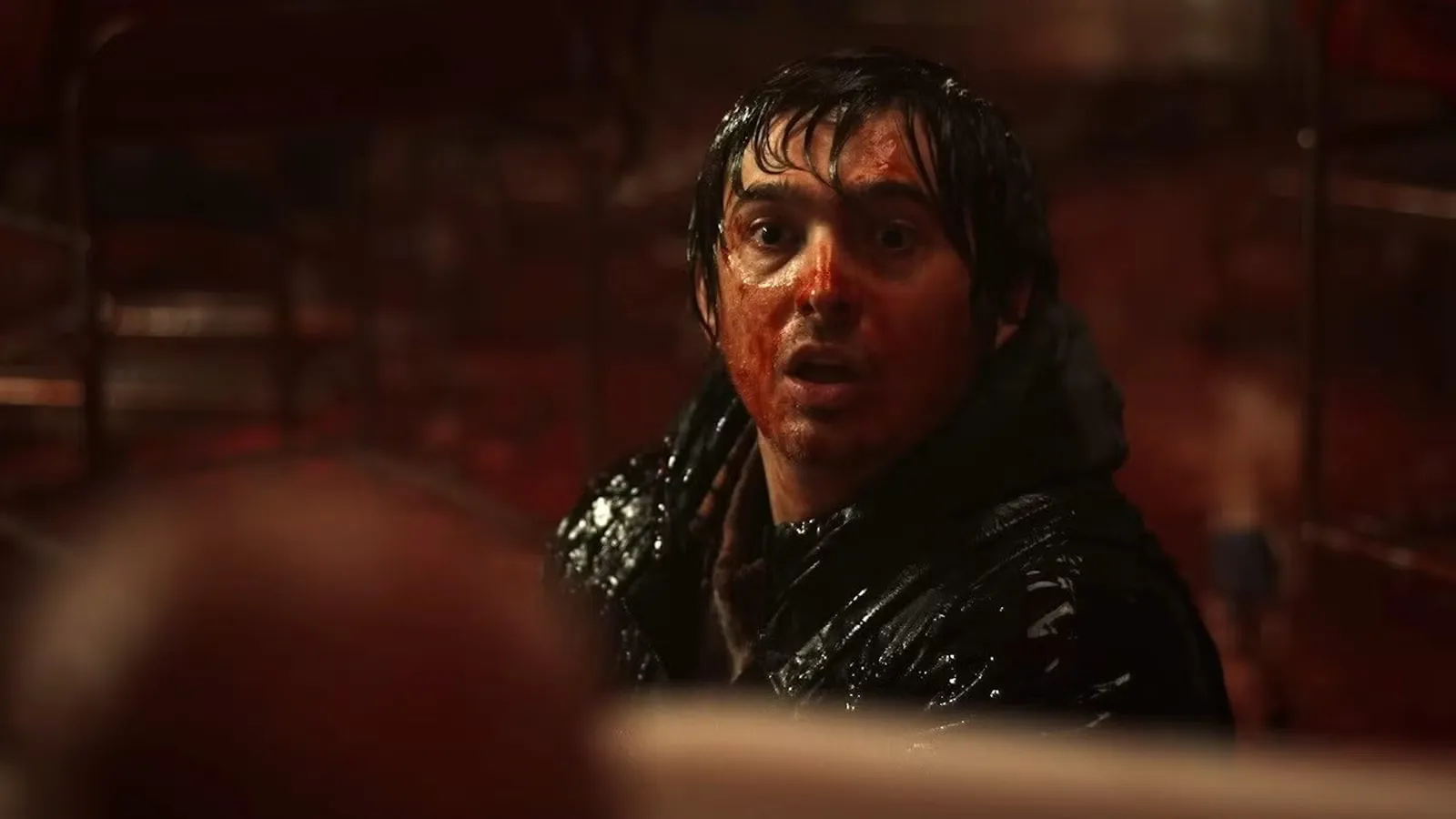
To give you a sense of Zach Creggor’s unsparing video game adaptation, let’s start with a scene about a third of the way in. Our hapless hero, Bryan (Austin Abrams), a medical courier stuck out in the wilderness of frigid Upstate New York, has already had an exceptionally bad night dealing with mutated zombie-like humans, when he comes across a terrified young girl hiding in the bathroom of an otherwise deserted RV parked askew in the middle of a tunnel strewn about with other smashed cars and debris.
It’s exactly the kind of move a more sentimental film might make, to saddle the hero with a young child (see also Aliens) whom they will now have to protect along with everything else. But as Bryan leans down to try and help her, the peculiar, tentacled mass that was once the girl’s left foot snatches at him, trying to draw him closer to her now exposed toothy maw. Pulling free, Bryan scuttles across the floor of the RV, grabs his recently acquired shotgun, gulps, and shoots her to bloody pieces, spattering his face with a fresh round of gore. Pushing out the backdoor of the RV, he mutters to himself how he didn’t just “shoot a girl in the face” even though that is precisely what he has just done.
This film, now the second reboot of a series that has seven previous installments, isn’t terribly interested in pity, conscience, or redemption. In fact, despite the trappings of a more conventional horror caper — including a protagonist who has just learned he’s going to be a father — Cregger’s creation has no intention of going soft on us, all the way through the pitiless ending.
Based on the much beloved (and extensive) Capcom series of survival horror games — one of the original zombie shooters from the mid-’90s — Cregger, who co-wrote the script with former John Wick scribe Shay Hatten, had a glut of material available to him, but has instead opted to tell his own story within the RE infected universe. During preproduction, the director of such lauded previous horror flicks as Weapons, and Barbarian, alluded to the fact that this was a story he would have wanted to tell regardless of the game tie-in.
Since Constantin Film’s most recent film adaptation, 2021’s reviled Resident Evil: Welcome to Raccoon City, was shunned by critics and gamers alike, the production house sagely sought a different path for their new series, offering Cregger (a huge fan of the games, as it happens) the chance to helm an installment with a great deal of creative freedom.
The result of their gamble pays off in significant ways — true to Cregger’s word, the first third of the film doesn’t feel like a game adaptation at all, but a well-measured standalone spooky thriller — even if, by the film’s conclusion, the gameyness has returned with a vengeance.
Bryan is already having a wretched night by the time a doctor gives him a medical pouch to deliver up in the mountains during a snowstorm. His girlfriend, Michelle, newly pregnant, is deeply unhappy with his response to the big news, and he’s under a good deal of pressure to drop off this package as soon as possible, even as the roads become more ice-and-snow encrusted.
When he unwittingly hits a woman who leaps out of the woods into the pathway of his car, his night goes from bad to worse in a hurry. He finds her, bloodied but alive a bit deeper in the woods and packs her into his car in order to take her to the hospital where he’s dropping off the package. En route, he gets pulled over by a sheriff, chased by a seriously deranged dog, attacked by a couple in a farmhouse, and ends up trying to hoof his way to the hospital through that abandoned tunnel.
Eventually, Bryan is given a bit more of an explanation for the strangely violent goings-on (a leaked bio-weapon, naturally) — that medical bag turns out to contain a major component of the antidote that’s needed to reverse all the horrible mutations that have hit the area — and a mission: He needs to go up to the top floor of a hospital high-rise in Raccoon City where there’s a consortium of scientists behind a secure lock-down waiting for the bag’s delivery.
Given the medium’s constraints, Cregger fashions a solid hybrid of personal vision with existing IP — at times, he actually embraces the RE vibe by inserting a series of POV shots from behind Bryan’s ever-evolving array of weapons — which he achieves, in large part, by meticulously planning out his shot sequences, and not taking any scene for granted, and infusing the film with carefully orchestrated misdirections and feints.
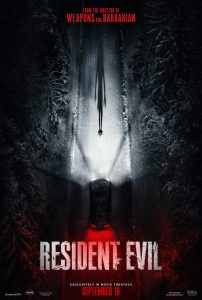
In one such sequence, where poor Bryan (“I suck at guns”) is being chased around an overturned car by a zombie woman, the camera almost gleefully follows his looping trajectory, so we can see just over his shoulder what’s coming behind him, right until he stops, and the camera suddenly sweeps the other direction, leaving the audience gasping at what might still be waiting for him back the other way. In another, Bryan’s car plunges ahead in the snowstorm, the headlight beams illuminating the menacing, snow-laden trees on either side of him before flicking off like the timing lights in a huge storage facility, the car getting smaller and smaller in the distance as black continues to fill the screen (a moment hinted at with the film’s fantastic poster above).
This methodology works almost shockingly well in the film’s first half. Bryan appears to be living one of those nightmares where you start out with one task and are pushed further and further away from its completion, even as you continually forget just what it is you were meant to do in the first place. Abrams, scruffy but resilient, presents an engaging gateway protagonist — not one to suffer in silence, he spends a great deal of the film muttering evermore explicit profanities under his breath — and the cinematography, by veteran Dariusz Wolski is expansive and lush, presenting every setting (farmhouse, sewer, hospital stairwell) with a kind of atmospheric specificity that greatly helps sell Cregger’s vision.
For a while there, in the film’s opening act, I thought I’d really stumbled onto something extraordinary, but as the story progresses, and Bryan gets his series of missions, you can feel the film slip back into something more conventional, such that by the end, even as it holds the line as far as sentimentality goes, there is a distinct feeling of narrative let-down. I’d say Cregger does far better than most for what is generally a pretty lacking genre, but, I’m afraid somewhat to the film’s detriment, by the end, he still duly gives the gamers their due.