
Whereas many modern auteur directors have a recognizable signature style — think Wes Anderson, Martin Scorsese, or Wong Kar-Wai — Paul Thomas Anderson, American paragon, tends to let the material dictate much of a given film’s construction. From the long takes of Punch Drunk Love, to the long shots of The Master, Anderson morphs with each project, such that every film in his oeuvre has a specific look and feel.
For this film, a loose adaptation of Thomas Pynchon’s novel Vineland, the shots vary between languid and almost thunderously violent, from the lilting trills in Jonny Greenwood’s soundtrack, to abrasively coarse auditory punch-outs. At times, it’s like the effect of flipping through random channels on your TV, the sudden change of tone and timbre shocking you with their contrast.
Take a scene near the beginning. with a ragtag group of ‘90s would-be revolutionaries robbing a bank. At first, the heist seems so well choreographed as to be almost de facto (one female revolutionary struts atop the bank tellers’ desks announcing her name, “Jungle Pussy” while her comrades keep everyone else under gun surveillance), but when something goes wrong — as you sort of know it will — Anderson’s pace and tone instantly become more frantic and jagged, edits are made seemingly on the fly, from blurry hand-held shots, to barely-on-frame snippets, the soundtrack suddenly pummeling the audience with dissonance.
It’s a fair cinematic reflection of Pynchon’s equally dissonant writing style. Anderson, who adapted the author’s Inherent Vice back in 2014, seems to have found a kindred spirit in the famously off-beat novelist, whose work ranges between languorous satire and rollicking counterculture yarn.
We meet Perfidia Beverly Hills (Teyana Taylor) as she is quietly casing a make-shift immigration camp off an L.A. highway ramp. Along with the fellow revolutionaries of the so-called “French 75,” she plans to infiltrate the camp and free the many Latinx families being held there as a means of disrupting existing societal structures and ultimately overthrowing the fascistic patriarchy of the U.S. government once and for all (yes, given our current regime, this hits right between the eyes).
As her romantic partner, Bob Ferguson (Leo DiCaprio), the “rocket man,” plants a series of explosives and fireworks around the enclosure, she and her team make short work of the national guardsmen who were supposedly standing watch over the place. That is, until she confronts the base CO, Stephen Lockjaw (Sean Penn), a ruddy-faced leatherneck sporting a military buzzcut with a tuft of hair on top like a rooster.
They share instant, peculiar, chemistry, albeit in limited fashion in the short time they spend in each other’s presence. The success of this mission emboldens the group to stage other classic, ‘60s-era style provocations, from bombing municipal buildings (after hours), to robbing banks to fund their other, more direct political exploits.
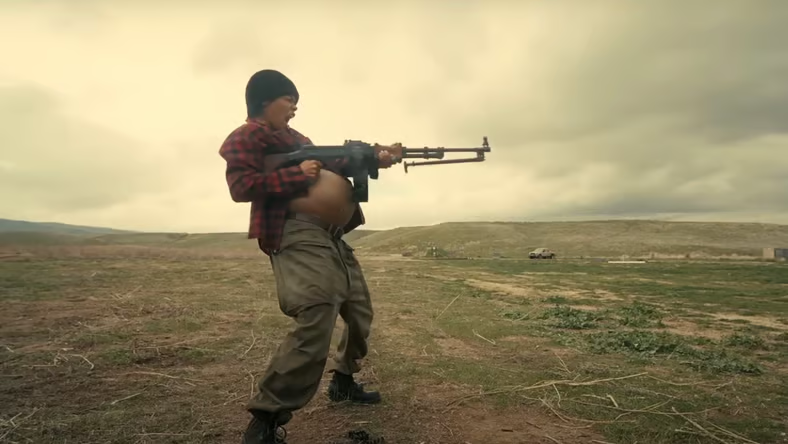
In the film’s first act, time moves in halting, elliptical bits, like a dry leaf caught in a low-level water stream. We see a continuing, twisted trist between Perfidia and Lockjaw (as he intercepts her in the middle of one of her operations, but doesn’t arrest her, it’s pretty clear his corruption is almost total), and, then seemingly months later, Perfidia firing automatic weapons while heavily pregnant with child.
After the birth of said child, Charlene, it’s pretty clear that Perfidia isn’t cut out to be a mother. Against the strong wishes of Bob, she continues to leave for criminal escapades along with her remaining revolutionary sisters, so committed is she to the cause. But upon getting pinched after that bank heist goes so terribly wrong, with Lockjaw’s help, she rats on her fellow French 75 members in exchange for immunity and witness protection, which she then uses to abscond from Lockjaw and everyone else she’s ever known. In the resulting chaos, many former members are killed or arrested, with only a few managing to escape and go as off the grid as possible, including Bob and his baby girl.
Next, we jump ahead 16 years, with Charlene (now known as Willa, and played as a teen by Chase Infiniti) living with her ever more paranoid dad deep in the New Mexico woods, knowing only of her mother dying “as a hero” according to Bob. It’s been long enough that most of the heat has died down on the two of them, and the other surviving members, including Deandra (Regina Hall), a kindly soul who keeps an eye out for the pair.
That is, until Col. Lockjaw gets an opportunity to join with the ultra-fascist white supremacist order known as the “Christmas Adventurers” (“Hail St. Nick!” being their gleeful sign-off). He’s very much interested, but realizes he will have to tie off a few loose ends in order to get past their extensive background screening program (the possibility that Charlene/Willa is his own child with a Black mother would obviously be a means for his rejection).
Now, with a military battalion behind him, Lockjaw seeks to find Bob and his possible daughter and wipe them off the map before his game is given away, causing the perpetually stoned and dour Bob to clear out the cobwebs of the past decade-and-a-half, and get back into revolutionary survival mode.
As with Pynchon, there is a sort of background thread of failed politics in the film — beyond the more obvious immigrant detention centers and Yuletide paramilitary supremacist orders — in the ultimate failure of the French 75 to enact the sort of seismic change they were clamoring for, the would-be Marxists working in solidarity, undone by the selfish impulses of their individual members such that everyone is put in harm’s way (even the true believers are shown to be vulnerable when their families are threatened).
Everyone is so quick to drop their vows and beliefs in the face of punitive pressure, it becomes clear why so many like-minded rebellions fail to achieve their goals, the self-sacrificing only going so far before giving way to self-protection.
That is, except for the idea of true — not conjured — family. When Bob does finally leap into action to save Willa, he does so without regard to his own care. The film, of course, posits the irony of this: Bob’s dedication to a child who might not be genetically his, vs. the beyond callous and contemptably selfish actions of the man who well may be her father, all too willing to have his child murdered in order to achieve his own power-hungry goals.
It’s a good role for the perennially single DiCaprio, who I’ve long accused of being unable to believably convey parenthood, in that his paternity is actually in question. He brings a suitably shaggy aura to his performance, a man who via lust, the fever of belief, and/or chemical dependence, has never really contemplated his own life terribly much. In this, Infiniti is also tremendous, reflecting her mother’s conviction minus her twisty, ego-branching weakness.
But the film more or less hinges on Penn’s loathsome Lockjaw. He has always been an actor who uses different body language to inhabit his character’s persona. Here, with his rigid, bow-legged Colonel, his head like a matchstick, his halting gait as if his legs are perennially asleep, he’s a thoroughly regrettable creature, vain and oblivious to his own glaring hypocrisies. Penn has always been able to enact such men — an avowed leftist, he seems to delight in portraying grim military careerists — but the ruthlessness of Lockjaw allows him to delve deeper into his character’s psychosis. It’s a sublime effort.
For Anderson, after the more slight nature of his previous feature, the enjoyable Licorice Pizza, it’s a triumphant return to larger, more complex narratives. The film hums with energy and purpose, even as the director and his production team — alongside that bonkers score from longtime collaborator Greenwood — work to unhinge the audience from time to time (a series of dizzying POV shots from a car grill near the end place the fear of God in any viewer contemplating driving on desolate Western highways) in service to the film’s purposeful, off-kilter effect.
The film ends on a relatively warm note, but still making its subtly satiric point: We see Willa climbing into the driver’s side of a car, about to head out purposefully, accompanied by the film’s last stellar music cue, a popular ‘70s FM radio standard we have most certainly seen utilized to a solid effect in a completely different sort of film (Jonathan Demme’s The Silence of the Lambs). Yes, the progeny of a Black radical revolutionary and (likely) white military fascist is, as the film cheerfully informs us, indeed in all the ways that matter an “American Girl.”