

NOTE: Generally, film reviews are designed to inform the reader of the quality/success rate of a given film, in order to give them a better sense of what they might expect and to help them decide if a film is worth their money or not. In this singular case, I would STRONGLY suggest NOT reading this review until you’ve actually seen the film. Such is the nature of this Paul Feig-helmed effort that it works best for viewers who have very little idea of what to expect. My advice, then, is to go while knowing next to nothing about it, and be prepared to question your life choices for the first two acts. Trust me, it will eventually seem more worth it than it would seem at first. You can always come back to the review: We’re not going anywhere.
Spoilers Ahoy: In one very early bit in the ’70s from the late comedian/provocateur Andy Kaufman, he appeared as a hapless nobody on stage, a nervous, awkward schlep who was absolutely dying under the audience’s gaze — right up until he happened to put on a record with the Mighty Mouse theme song. “Here I come to save the day!” he suddenly mouthed along with gusto and assuredness, before going back into his Latke-like shell. Gradually, the audience began to get in on the joke, and they got a shared experience with him, who was risking everything in order to trick them. The most shocking aspect of Kaufman was his almost gleeful disregard for audience endearment.
A similar scheme is hatched in Paul Feig’s film, although I have to be extremely vague about the details so as not to ruin the carefully plotted set-up. Suffice it to say, there’s a good chance you will utterly loathe the film as I did for almost the entire first two acts before the reward comes your way.
The plot will seem deeply familiar to anyone with a working knowledge of the endless glut of Netflix-style suburban, female-driven dramas: Millie (Sydney Sweeney), a young woman just paroled after a lengthy prison stay and in desperate need of a job, gets hired by Nina (Amanda Seyfried), the matriarch of a lavish Great Neck mansion owned by her romance-novel-cover handsome husband, Andrew (Brandon Sklenar).
At first, Nina is a doll, and Millie feels as if she’s been delivered by the angels, but very quickly, it becomes clear that behind the scenes, Nina is completely psychotic, throwing fits and falling into jagged crying hysterias over any random-seeming affront. Her dour young daughter, CeCe (Indiana Elle) from a previous partner, is thrust into Millie’s care, the house is frequently a disaster zone, and Nina threatens to fire her regularly.
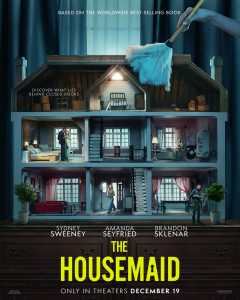
The only thing keeping Millie afloat, it would seem, is ever-kind and patient Andrew, a hunk of a man prone to wearing tight sweaters tucked inexplicably into his pants, with an unwavering scruff of stubble, and gym-endowed body whose every muscle ripples meaningfully. You can certainly see where this is all headed, especially after Millie is told via the local gossip circuit, that Nina once tried to drown her then baby daughter, and had to spend significant time in a psych ward as a result.
Naturally, one thing leads to another, and another in all the ways you can predict, with Millie and Andrew growing closer together as Nina falls further and further into madness — at least, right until the film decides to actually show its cards, throwing everything you’ve just witnessed into question.
It’s a peculiar experience. At first, the audience at the public screening I attended, seemed to be suffering the same eye-rolling despondency I felt — cat calls were frequent, as were bouts of giggles when studly Andrew tried to make incredibly stilted small talk with the comely Millie — such that when the tables do get wildly overturned, as it were, the crowd, once near hostile towards the film, whipped around a breakneck 180 and cheered genuinely enthusiastically at the various goings-on.
In this, Feig, the creative and comedic genius behind “Freaks & Geeks,” regulated to Suburban Upper Class Female Dramas, by dint of his success with A Simple Favor and its sequel, seems to have pulled a bit of a Hitchcockian twist, taking the genre he’s likely best known for amongst film goers, and subverting it in a way that feels genuinely shocking and brash.
As the actors go, one can only imagine the fun they might have had taking these doleful tropes — the blitheringly charming wealthy scion; the brittle, emotionally unhinged wife — and playing them to their full hilt, in service not to their further embodiment, but to quite the opposite. It also explains how Seyfried, in particular, an actress of rare distinction, can seem so incredibly misguided in her depiction of psychosis (“couldn’t be less convincing” I scribbled disdainfully in my notes).
Other than these quick observations, the less said about it the better. It will be fascinating to see how the general public, unfamiliar with the source novel by Rebecca Sonnenshine, will react to such a successful flim-flam. Suffice it to say, if you can bear the first two acts without walking out, you will be richly rewarded by the end.