
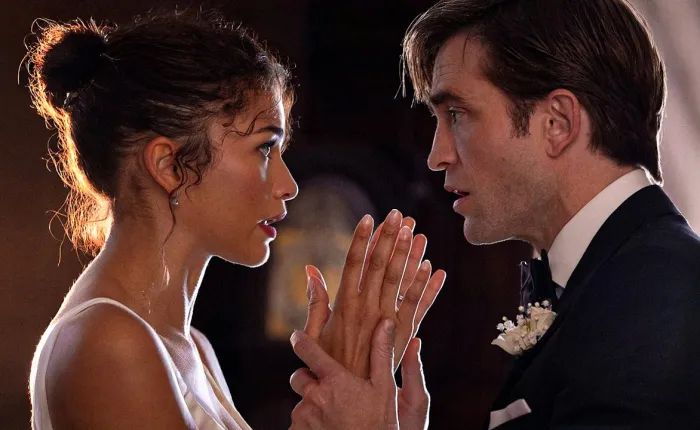
Imagine you’re sitting around with a group of friends, drinking wine, cracking jokes, feeling pretty good about things. Then, one of them, trying to be silly and provocative, asks the group to describe the worst thing they’ve ever done. Hilarity ensues. One person has a story about being a cyber-stalker when they were a kid. Another talks about how they once used their ex as a human shield against a snapping dog. When your turn comes up, it’s kind of unclear how honest you are supposed to be: Should you choose something easy, sellable — say, you broke up with someone on the first day of their trip to come and see you? — or actually answer the question as presented: The. Worst. Thing. You’re drunk. You’re among friends, including your fiance, set to marry you in a few short days. You trust them, you think, they should know you by now, right?
This is the dilemma in which Emma (Zendaya) finds herself, the night she, her loving fiance, Charlie (Robert Pattinson), and their best friends, the married couple Mike (Mamoudou Athie), and Rachel (Alana Haim), meet at their wedding caterers to finalize the menu. The decision she makes — and we’ll very much do our best to be spoiler free as possible here — ultimately affects everything about their upcoming nuptials.
They met, as they put it, “cute.” In a Cambridge, MA, coffee shop, Charlie instantly taken with the winsome woman sitting by herself, reading (the fictional) book, “The Damage.” Not having a clue about the novel, he quickly googles it and gets the gist, enough for him to be able to approach her to say just how deeply meaningful it was to him. Alas, his pitch to her goes ignored and unheeded until he makes a point to try again, this time causing her to pull out her headphone, revealing that she’s deaf on the other side.
Having gotten over that initial hurdle, the couple quickly take to each other, and move in together. We get a sense of their two-year history as Charlie is trying to memorialize it in his wedding speech, bouncing ideas off of Mike. Maybe he should include something about their riotous sexual connection? Mike thinks that’s a terrible idea. Maybe he can say something about her laugh — infectious and silly — while writing, mostly facetiously, that it’s also “repulsive”? Again, Mike discourages it.
This is in the culminating week of their engagement, with many friends and family members flying in from all over. Everything seems idyllic (adding to their joy, their beautiful, spacious apartment, with its spiral stairs taking them to their bedroom loft). Charlie has a job with the Cambridge Art Museum, Emma works at a book publisher’s, and their lives seem perfectly intertwined. A couple of destiny.
That is, until, that fateful night at the caterer’s, Emma tells her story, shocking the other three, leaving Rachel personally outraged, and Charlie himself having to question everything about his soon-to-be bride. Suffice it to say, in her youth she very nearly went down an extremely dark path. Now, with the couple mere days away from finalizing their lives together, the tightly wound thread of their relationship begins to unravel, leaving both of them desperately trying to hang on to whatever’s left.
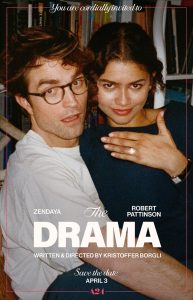
We see this contretemps more from Charlie’s perspective than Emma’s — though, via flashback (with Jordyn Curet playing the young, troubled Emma) we get enough of a sense of her situation to at least get a partial view of the forces at work — as the young lion begins to stumble and collapse onto himself. At one low point, he asks Misha (Hailey Gates), a co-worker, how she might feel with this “hypothetical” situation, a bad idea that becomes even worse after he completely falls apart talking about it, things getting even more unfortunate from there. All of which leads to the wedding day itself, with everyone disgruntled and discombobulated with one another.
It sounds like the set-up to a comedy, and to be sure, writer/director Kristoffer Borgli (himself, the cause of controversy, given his recent admission to dating a teenager when he was a decade older than she), plays a lot of this material for uneasy laughs. The wedding scene itself, at the end, is a sort of culmination of everyone’s bad choices in the most public of spectacles (Charlie makes an absolutely ghastly wedding speech resulting, in part, by him getting his nose broken by an angry guest), with various turns of the screw.
Only, it certainly seems as if Borgli is after something deeper and more disturbing than a simple cringe-conscious wedding comedy: The very nature of Emma’s admission is indeed disturbing enough for everyone in the audience to reconsider her. In this way, full accolades for the casting of the inimitable Zendaya, an actress whose infectious charisma is almost impossible not to find endearing, even as the character proves herself to be decidedly more disturbed than anyone — including the hapless Charlie — might have suspected.
To be sure, Borgli ensures that Emma’s not alone in her decrepitude. For all her rancor towards her friend’s confession, Rachel’s horrendous story involves her taking her special needs neighbor into the woods and locking him overnight in a closet in an abandoned house — a point the film doesn’t shy away from, to its credit. Charlie himself, laughingly admitting to making a young contemporary cry by cyber-stalking him, is also disturbingly callous, even as he giggles in the telling of it. If we were to really investigate the “worst thing” we’ve ever done, the film strongly suggests, we would all come across like monsters. The question becomes where the line is drawn between acceptable skullduggery and antisocial psychosis.
It’s the strong hint of deeply bitter chocolate that makes this particular cookie memorable. That said, despite the film’s herculean efforts to make her seem as a complete, complex woman, Emma’s past and her present still don’t really square up terribly well. It would have been a much more successful trick had Borgli managed to find the common threads between herself as a teen, and as a seemingly well-grounded woman. To this end, having Emma be the lightness in Charlie’s life, the goofy one always forcing him to take himself less seriously, seems incongruent with what we eventually learn of her past.
And, for all the film’s adherence to a quirky, mixed tone, the ending — telegraphed as it is — comes across less like the inevitable solution, and more as if Borgli decided to pull out the Taser lancets and ease up on his characters. Is the idea that we all have this darkness, and only when it is faced that we can truly be united with someone else? For the film’s sake, I’d like to say it wants to be more ambiguous than that, but as with its embattled female protagonist, it’s difficult to give it the benefit of the doubt.

1 Comment
As usual, this is a thoughtful and thought-provoking review by this critic. He not only discusses the film itself, but situates it in a larger context about this director, these actors, and this genre.