
Few writers love their fictional characters more unconditionally than Quentin Tarantino. Over his nearly 40-year career — and, famously, nine films he both wrote and directed — he has shown time and again how much he adores them, and loves to hear them speak to the point where nearly everything else stops around them. At its worst, this sort of monologue-heavy approach can feel indulgent (the back-and-forth dialogue between the Bride and Bill in Kill Bill, Part 2 certainly comes to mind, but there are a host of other examples), which can feel as if stuck at a dinner party where one guest continually dominates the conversation. Suffice it to say, QT becomes enthralled by his characters, and loves to give them a bully pulpit. Kill your darlings, he may, eventually, get around to (Bill comes to his end via the Bride’s successful employ of the “five point palm exploding heart” technique after all), but not before they’ve had a chance to speak their minds — at great length..
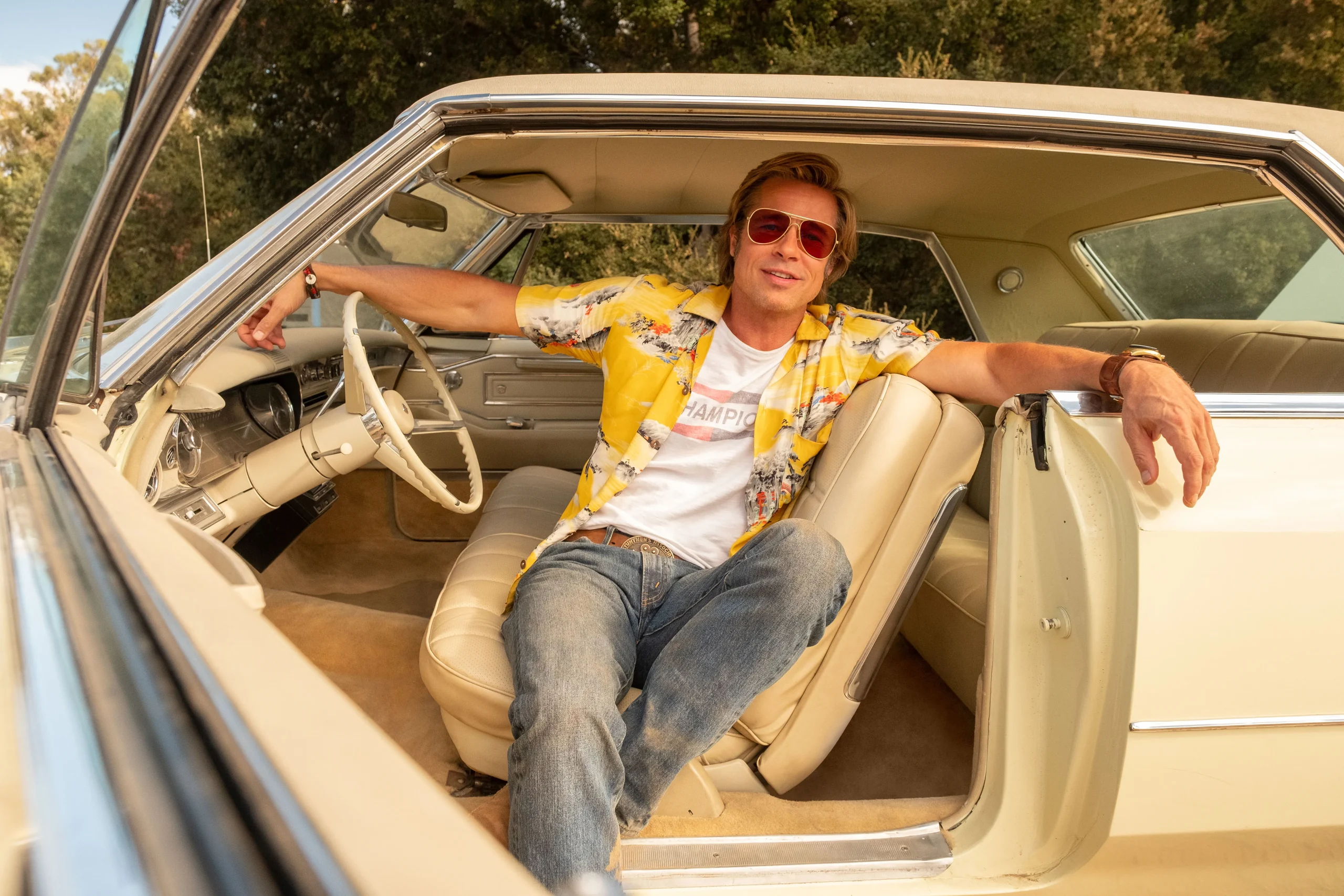
Amongst his all-time favorites, I believe we can safely add Cliff Booth (Brad Pitt), the behind-the-scenes stuntman from Tarantino’s last helmed effort, One Upon A Time in Hollywood. Booth, whose swag and self-bemusement are a seamless fit for Pitt, stole the movie right from under famous leading man Rick Dalton (Leo DiCaprio). Good natured and game for seemingly anything, in OUATIH, Booth got into a brawl with Bruce Lee, worked shirtless on a roof, made a box of Kraft Mac and Cheese in a pan, and wiped out the Manson Gang without ever losing his perpetual grin.
As if QT could ever love a character more, the setting in late ’60s Hollywood, also allowed Booth to hobnob with the rich and powerful in an era of American cinema considered the Studios’ peak of artistic/entertainment fusion. Mis-adventures is less a sequel than an expansion. It might not be Tarantino directing his 10th — and reportedly last — film, but he has bequeathed his script to David Fincher, a director every bit as demanding and fastidious as QT himself: a match seemingly made in cinephile nirvana, if only the effect felt more organic.
In this film, set in the mid-’70s, about a decade after we last saw him, Booth is still riding pretty high on the hog. In between running a rep house movie theater (Fincher inserts many loving shots of Booth working from the projection room, switching edit points, and rolling the reels back to font), and working at various wild bars and nightclubs mixing drinks, he’s also rolling in demolition derbys, and taking loving care of his elderly pop (Peter Weller), who spends most of his time outside of his pawn shop at home in his apartment in Marina Del Rey watching old movies.
What he’s not doing much of, it seems, is working as a stuntman, anymore, which is why it comes as a surprise when he gets a call from Karen Crosby (Elizabeth Debicki), the agent for TV star Charlie Peters (Scott Caan), trying to arrange a meet. A few rounds of drinks and doubles tennis later (the latter presented in a laconic montage), the squirrelly Peters finally takes Booth aside and hits him with the actual pitch: Apparently, while on a movie shoot in Manila a few months back, Peters, hanging out with a drug lord named Verdusco, happened to mention to a pair of the drug lord’s uber-violent nephews (Ariel Felix and Matt Groove) his desire to have his wife, Toni (Carla Gugino), an actress who used to date Booth, murdered. Having thought better of it since returning to the States, and rekindling his marriage, Peters wants to call off the hit, but without having to pay off the brothers the agreed-upon price.
Out of care for Toni, with whom Booth still has warm feelings, he agrees to serve as an intermediary between Peters and the pair, but things take a turn when the bros put a major hurt on one of Peter’s co-stars, Rodrick Harrison (Yahya Abdul-Mateen II), causing Booth to reassess how to best play out this hand.
On the way, he also spends a good amount of time courting the comely Crosby, with whom he establishes a sort of masochistic interlude (with her smacking the hell out of him), and doting on his affable father, among many, many other interests. As QT has it, Booth is a kind of riff on the ‘Most Interesting Man in the World’ from the well-known Dos Equis ads: In addition to being a stuntman and working with some of the biggest actors of his era; the wiping out of the Manson Family; the incident with Mr. Lee; and his Demolition Derby driving, he’s also spent time during WWII killing Japanese and German soldiers with impunity (to the point where his name is hallowed to this day in the Philippines); while also apparently working off and on in the porn industry (he’s known for a film called The Sexorcist). One of the film’s ongoing jokes is that everyone Booth meets says he looks familiar. He plays all this down, of course, but it turns out there’s a likelihood that people do recognize him — for all sorts of reasons.
His lifestyle might be interesting, as the film indicates, but is Booth actually substantial enough to build an entire movie around? At times, as charming as Pitt is, and assured as Fincher’s direction may be, the film suffers a bit from having to justify its existence. As a side character in the larger panoply of OUATIH, Booth lit up the screen every time he appeared, as the main course, it feels a bit like that bowl of mac and cheese he mixed up in the first film: Tasty, but not entirely satisfying as a whole meal, even as the last third of the film feels more elegiac about its aging protagonist.
This lack of gravity doesn’t come from a lack of trying on Pitt’s part. With Booth, he gets to fill the shoes of one of the more Pitt-ian creations ever set to film, a dude so laid-back and cool, no situation seems to get the better of him. With a perpetual grin, and a devil-may-care countenance, he’s like the platonic ideal of a Hollywood icon, too cool to read his own headlines, but living his life in such a way to ensure there will always be more of them.
As for the script, QT seems to be pillaging some of his own greatest hits package — the Verdusco brothers, who get lost trying to find the address of another house whose occupants they plan to savagely murder, banter back and forth like Vincent and Jules from Pulp Fiction; a diatribe from Crosby, a former film critic, about movies not being art recalls Bill’s monologues about the nature of Superman, and so forth — and also feels a bit undercooked as a feature production. It’s like something you might have looked forward to as one of the bonus extras on a particularly robust Blu-ray release of OUATIH.
Instead of character development, QT stuffs his script with various homages to ‘70s cinema (including Blaxploitation flicks: The film actually opens on the last scene of a fictional title called Soul Brothers Die Hard), and easter eggs from the previous film, as well as numerous other ‘70s callbacks, including “Hee Haw,” a Kool Aid commercial, shots from the premiere of Looking For Mr. Goodbar, scenes from an episode of “The Rockford Files,” and, naturally, Booth’s own car, a Pontiac LeMans convertible (in one scene, Booth is even wearing a white “STP” shirt, to complete the effect).
Despite all the attention to this sort of detail, the film never quite gets past its own shaggy dog-ness. Booth is a hell of a guy, and has a life of (mis)adventure a lot of people might die for, but as a lead character, he’s pretty impenetrable emotionally, which makes him a good deal less compelling as the film’s fulcrum. Ironically enough, it turns out he’s a lot more engaging as a stuntman than a leading man.