
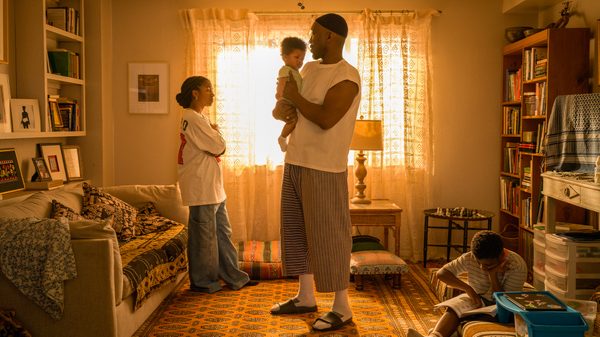
About midway through Bassam Tariq’s excellent spiritual/assassin mashup, Qadir (Jahleel Kamara), the 10-year-old son of our stolid protagonist, Latif (Mahershala Ali), is sitting on the couch, watching a Rambo movie. Normally, the Muslim, strict-minded Latif doesn’t want his son watching films with guns in them (he also doesn’t like him playing video games with guns), but on this one occasion, he lets it slide.
By this time, he has much bigger issues at hand, but the significance of Sly Stallone’s perpetually underestimated one-man killing squad making an appearance is not lost on us. Latif is newly widowed, with three children, including Qadir, his teen daughter, Fatiha (Aida), and an infant daughter in need of breast milk. Before the untimely death of his wife, he has worked as a sort of retributive assassin — when we first see him, he’s on the job in a deadly beat down with one of his targets — under the guise of working as an avenging warrior for God, and, to a lesser degree, doing hits for Mike (Laith Nakli), an Arabic businessman whose interests Latif routinely protects from seemingly godless heathens.
In need of money, as well as the milk, Latif is given a new target by Mike, Pastor Hwan (John Cho, with a ratty beard and manic look to his eye), whose militant evangelicalism has taken aim at noted “Halal porn” producer Hatty (Abubakr Ali), a bratty, self-aggrandizing Gen-Zer, with dye-blonded hair and a feckless disposition, who also happens to be Mike’s nephew.
Latif is less than interested to get involved, apart from everything else, Hatty, a former Quran student of his from years back, has become an amoral tastemaker who traffics in women and vice, and hardly seems worth the effort. But, as these things tend to go, even with Latif’s attempts to steer clear of this blood feud, he and his family get intricately involved, leaving him hunted by both sides as he tries to keep his kids safe, and his dwindling spiritual belief intact.
There have been several such films that have taken a basic assassin story and tacked on some religious window-dressing as a kind of gilded frame around the resulting bloodbath. Action master John Woo, for one example, routinely set some of his most giddy shoot ‘em ups inside of churches (giving him yet another excuse to release his beloved white doves in the process), for a satisfying, if blunt juxtaposition (see also the end of The Godfather). But the gifted Tariq (Mogul Mowgli, Ghosts of Sugar Land) isn’t going for obvious analogies or cheap ironies here.
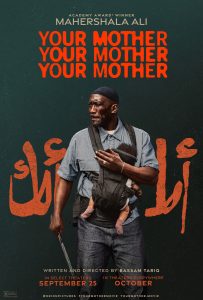
Instead, his film is essentially a treatise on spirituality and belief that just happens to have a protagonist who is caught in the moral backwash of their violent actions. Latif’s wife, we come to find, was far more devout than he has come to be (the title refers to a Muslim mathal in which a prophet is asked to whom one should give the best of who they are). In one scene as Latif has taken his family on the run during Ramadan, Qadir insists on leaving the car in order to do his proper prayers outside, leaving his father enraged, his mounting skepticism voiced mincingly (“Go ahead, see if anyone gives a shit,” he growls). His bitterness towards God has only grown since his wife’s passing (“I was your sword,” he says resentfully). But it’s pretty clear Latif (“Black ISIS,” as one Arab says) has sold out much of his godliness for the sweet paychecks Mike has cut at the completion of his bloody work, leaving the heavy lifting of the family rearing to his wife (more than once, the outspoken Fatiha calls him out for not having been around enough to make a difference).
Tariq’s film is almost baroque in its realization and detail: As much as the opposing forces want to be seen as being led by God — Hwan, upon another bloody “liberation” of a den of “unbelievers” raises his AK-40 to the sky in front of his white militant brethren and fires into the heavens, bellowing “Amen!” — they are all beholden to the worst, most barbaric instincts of humanity. And yet, unlike many other filmmakers who would have been happy enough to paint the enemies of Latif with a blood-soaked, broad-bristled brush, there is an element of actual belief, even among the Pastor and his wretched flock, a recognition of God’s work, even as it gets perverted by their incessant bloodlust.
For all the obviousness of the film’s would-be logline — a Muslim hitman with a family! — the film is actually far more complex and deep-reaching than one might suspect. The questions of spirituality aren’t just window-dressing here, they are the film’s raison d’être. As evidenced by its unexpected ending, which takes our expectations and doggedly confounds them, leading to a far more resonant close.
Reportedly, Tariq and Ali were hard at work for a very different project — the MCU’s new adaptation of Blade — but when the project was (unwisely) put into hiatus, Tariq pivoted from a half-vampire demon hunter with a sword, to a half-compromised Muslim warrior with several of them. The result is an extraordinary exploration of how deep our faith can take us. Lovers of Rambo’s brand of macho justice might not be satisfied, but Stallone’s muscle-bound avatar of masculine fury never had to worry about lugging around a cooler of breast milk in his saddlebags either.

1 Comment
Sounds very interesting. I’d like to see it.