
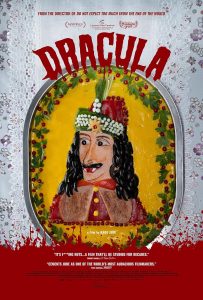
The traditional Dracula is, of course, known for draining his victims of blood and life-force. Not a great guy, but still not one you necessarily expect to command you to “suck” his “cock,” especially from numerous horrific A.I. interpretations of the character. As the literal opening line in Radu Jude’s riotous vampiric polemic, the irascible director is giving you a heads-up on what to expect for the rest of the film’s nearly three-hour runtime.
Jude, now a cagey veteran of such anarchic cinematic subterfuge (see Bad Luck Banging or Loony Porn, a time-capsule treatise on life in Romania during Covid), is a skilled satirist and sensualist. His approach in this film is less precise than the funny-but-damning Loony Porn, more content to cry havoc and let his freak flag fly wherever his muse dictates.
There are chapters, many of them, in fact. Amongst many digressions — including a series of Dracula-based TV ads, offering penis enlargement, family-friendly tours, and a host of other inanities — we have the film’s “director” (Adonis Tanta), a slight man with a high-pitched delivery, explaining how he tried to incorporate A.I. (the “Dr. A.I. Jude 0.0” to be exact) as much as possible into the sketches laid before us.
Hilariously, the film does include a great deal of hideous, often pornographic, A.I. imagery, alongside rustic, on-location castles, ridiculous cafe sets (with lighting rigs hanging overhead, visible set-quaking, and populated by life-size cardboard cutouts of extras staring at us from their tables), alongside the various running “storylines” the director has commanded from his A.I. helper.
In one throughline, a group of dinner theater performers feature an elderly man (Gabriel Spahiu) playing Dracula, alongside his “bride,” Vampira (Oana Maria Zaharia), as an audience of tourists and hecklers look on. Eventually, each performance (with an intermission, allowing paying audience members to have alone-time with the supposed Count), ends with the pair given a chance to run away from the restaurant and hide before the audience is given wooden stakes and flashlights so they can track them down.
Along the way, Jude considers the famous Romanian who inspired the character in the first place, Vlad the Impaler, a vicious sadist so addicted to torture, he resorted to animal and insect abuse during the brief time he was imprisoned for his horrific crimes.
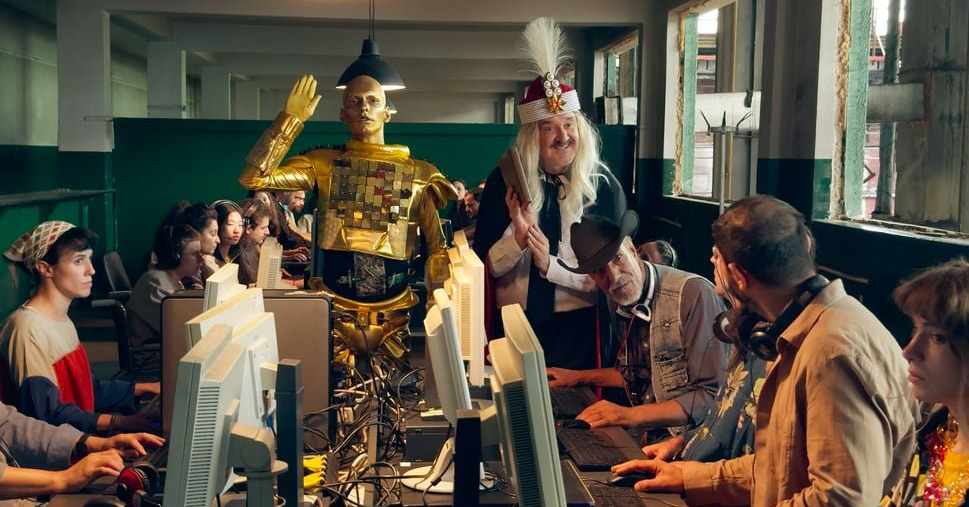
In one segment — seriously, imagine a kind of Eastern European Kentucky Fried Movie, only with vastly more penis representation — near the end, Jude plays out a kind of parable of the vampiric nature of capitalism, via a Socialist bent (as you can imagine, in a work setting with Dracula, and a hilarious A.I. golden-toned robot as your management team, things don’t go terribly well for the workers).
For all its inspired bits, however, there remains a shambling, shaggy dog element to Jude’s vision, the sense that he was having too much fun with his A.I. manipulations and irreverence to really sink his teeth (sorry!) into this project. Sections drag, conceits come and go, and, despite our “director” more or less informing us of his laziness, the film’s unfocussed charm begins to wear thin by hour three.
Eventually, after a section of “Drac TikTok,” our “director” ends the film on what appears to be a fairly straightforward piece following a garbage man attempting to watch his young daughter perform for a school history pageant. It’s as good a place as any to end the chicanery, I suppose.