
Back in 1961, a comic book writer and impresario named Stan Lee was assigned by his publisher at Marvel Comics to come up with a group of superheroes that could rival the success of rival DC comics’ Justice League of America, which connected virtually all of DC’s most popular heroes — Superman, Batman, Wonder Woman, the Flash, et al. — into a top-selling powerhouse of a title. Lee liked the idea, but rather than go with the stodgy idea that all heroes always got along perfectly well in their quest for justice, he came up with an alternate sort of group.
Lee’s vision was to have the four characters connected not by their heroic quest, but by something far more unstable and murky: family. There was brilliant scientist Reed Richards, engaged to the beautiful, independently minded Sue Storm; there was her younger brother, impetuous hothead Johnny; and, lastly, Reed’s best friend growing up in Brooklyn, Ben Grimm. When the four shot off into space with one of Reed’s early propulsion designs, the scientist hadn’t counted on the possible effects of a cosmic storm, with the intergalactic waves of energy shooting past the flimsy radiation shielding on the ship, and ripping through the four explorers.
Rather than killing them, after they crash landed back on Earth, they discovered they had each been given superpowers: Reed could now elongate and stretch his body like warm taffy; Sue could turn invisible and project forcefields with her mind; Johnny could burst into flame and fly through the air; and Ben became a molten, misshapen brute with incredible strength, known as the Thing.
Together, they defended the planet from any number of hostiles, including monsters from deep within the Earth, and monsters descending from the sky. They did so, however, despite the fact that, like any family, they fought and bickered, and often let each other down. Reed was brilliant, but emotionally distant; Sue was at times insecure about her relationship, and often worried about Johnny, who was egotistical and prone to bouts of teenage indecorum; and Ben, now a rock-covered monster, was bitter and miserable at having been transformed permanently, blaming his best friend for not being able to cure him.
The combination of elements worked incredibly well. Along with legendary penciller Jack Kirby, credited with much of the series’ success, and many of its plot lines, the two creators went on a legendary run through the ‘60s with the foursome, producing some of the most compelling and uniquely fun comics in the entire Marvel oeuvre.
Previous attempts to cinematically portray Marvel’s first family have fared, shall we say, poorly, from the Roger Corman-produced cheesefest back in 1994, to the reviled pair of early aughts flicks by Tim Story; to the even more despised misfire by Josh Trank, which led to many essays worth of angst about studio interference and the incredible pressure on young filmmakers to succeed at cost of their souls.
So, this time, with Marvel Studios finally in control of their first family, after Disney, their parent company, inhaled 20th Century Fox, the studio that previously held the rights to FF, the idea was that viewers would finally get to see the super-team as they were truly meant to be, a la what the studio did for Spider-Man back in phase three of the MCU.
Unfortunately, despite Marvel’s best efforts, the Matt Shakman-helmed film still isn’t able to capture much of the giddy energy of the early comics. The result is certainly dutiful, but a far cry from the genuine fun of the original source material.
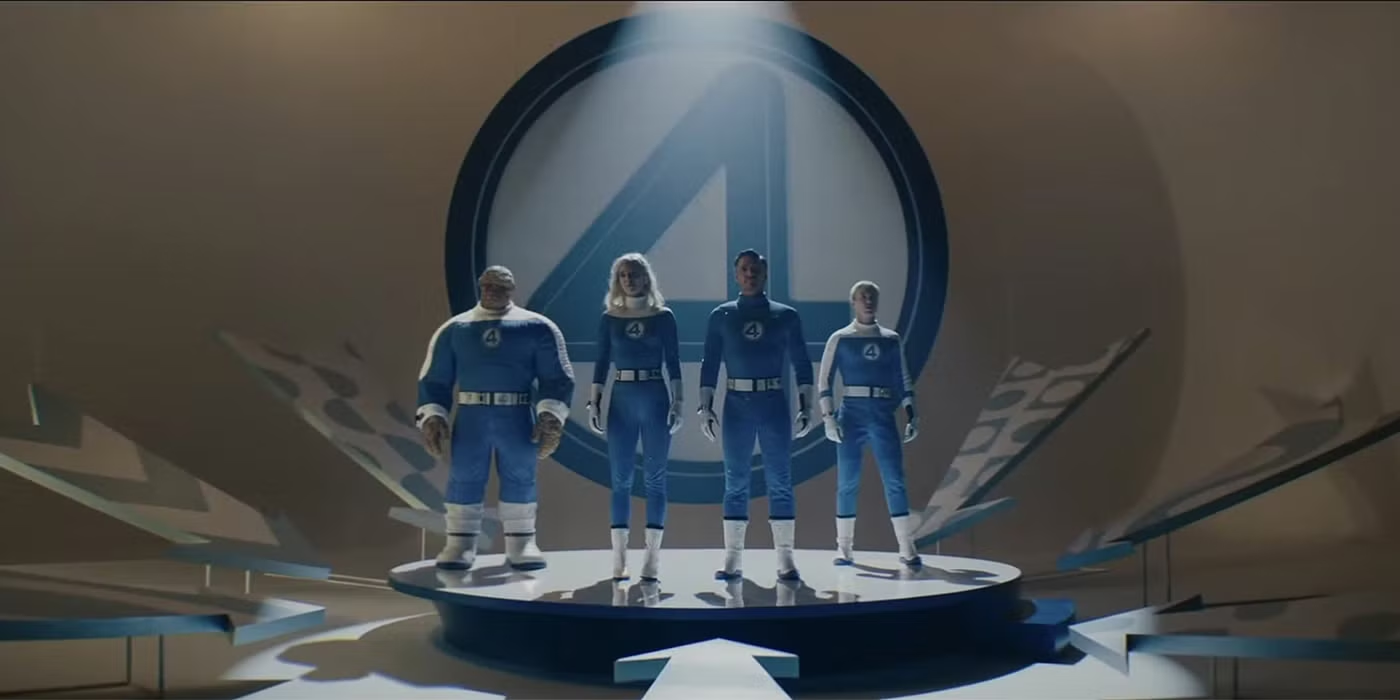
As the film opens, it’s already been four years since the intrepid adventurers returned to Earth as forever changed. Mind you, even as the film is set in roughly the ‘60s, this isn’t our universe, but instead, Earth 828, which allows for the course of history to be significantly altered from our own. In this Earth, Richards’ ideas and designs for futuristic technology have been universally accepted, so flying cars abound, computers are highly advanced for the era, and city architecture for buildings features bulbous lower sections along with severely tapered upper points that reach towards the cosmos.
In this version of Earth, it also seems true that everyone gets along, and the planet is a good deal more harmonious with each other (in part due to Reed’s idea for a sort of super-charged UN, that unites the countries together). The foursome, Reed (Pedro Pascal), Sue (Vanessa Kirby), Johnny (Joseph Quinn), and Ben (Ebon Moss-Bachrach), have met with universal acclaim and approval — it’s as if, in this non-polarized version of society, they’re a combination of the British royal family and the Beatles — as protectors of the planet. Even more so when it’s revealed that Sue is pregnant (presumably, she and Reed have gotten hitched already, though that’s never actually specified), with the world waiting with baited breath about the birth announcement.
Interrupting the good times however, is a shimmering, silver-clad female Silver Surfer (Julia Garner), who emerges from the skies to advise the planet that Galactus (Ralph Ineson), the planet-devourer, has chosen their orb to be his next feeding ground, and there’s nothing they can do to stop it.
It is put on the FF, then, to thwart Galactus’ dinner plans. At the speed of comic-book plot, the super-team retrofit their highly advanced rocket designs for hyperlight speeds, and head off into space to meet the giant, planet-eating entity in his own crib, so to speak. The meeting doesn’t go particularly well, with Galactus, who has taken an enormous interest in Reed and Sue’s as-yet unborn son, offering to spare the planet in exchange for their offspring.
When they return home, Reed foolishly spills the beans about the proposal at a press conference, and the team’s absolute refusal to meet those terms, which leads to very public backlash against them, even as Galactus approaches Earth with ferocious speed.
Shakman’s film has certain things going for it — including spectacular art direction from Nick Gottshock and his team that merges futuristic styles with ‘60s-era fashion that looks fabulous — along with a genuine earnestness that feels appropriate to the original comic. But the script, from a host of writers, including Josh Friedman and Eric Pearson, has been bled of any sense of spontaneous fun (in stark contrast, in must be said, to James Gunn’s far more entertaining Superman), and many of the plot points don’t bear much scrutiny — to name but one, why in heaven or hell would a woman eight-months pregnant be on-board an as-yet untested lightspeed ship en route to a meeting with a planet-ripping colossus, other than to give the planet-eater a chance to “scan” her body and discover that her cosmically-endowed fetus could somehow become the next bearer of his cosmic curse?
To be fair, many such plot holes exist in much of the early FF’s comic-book adventures — Lee and Kirby worked on many titles simultaneously, so there wasn’t much time for fact-checkers and story supervisors: Things worked well enough from a kid’s perspective, and that was more than good enough for comics at the time — but, even with the film’s stated retro-sylings, the throwback to a simpler time bit often comes out as nonsensical or cartoonish here.
While the casting is much improved over previous iterations — Kirby makes for an inspired Sue Storm, in particular — Quinn is less successful as Johnny, and the film suffers from a lack of character development, especially at the beginning, which should have given the family a chance to establish themselves a bit more successfully than Shakman manages. As it is, they are templates of characters more than actually lived-in ones.
Worse yet, the film, for all its retro-stylings, and general affability, is rarely much actual fun. The team doesn’t even really get to utilize their powers until near the very end, during the climactic final battle with Galactus. There’s the weird sense that the production team is somehow tasked with keeping things very close in check, as if trying to make the film while whispering very quietly.
If so, you can sort of understand why, as the MCU has famously cratered since their last real sustained success back in the 2010’s. A lot is riding on the next few films in the pipeline, even as rival DC Studios seems possibly reenergized by Gunn as their lead visionary. At least in this match up of comic book creations, the already successful Superman, while not a perfect outing by any means, at least seems to have kept in mind the most important mandate of the superhero genre, one certainly displayed by the Lee/Kirby duo: Be rippingly entertaining.