
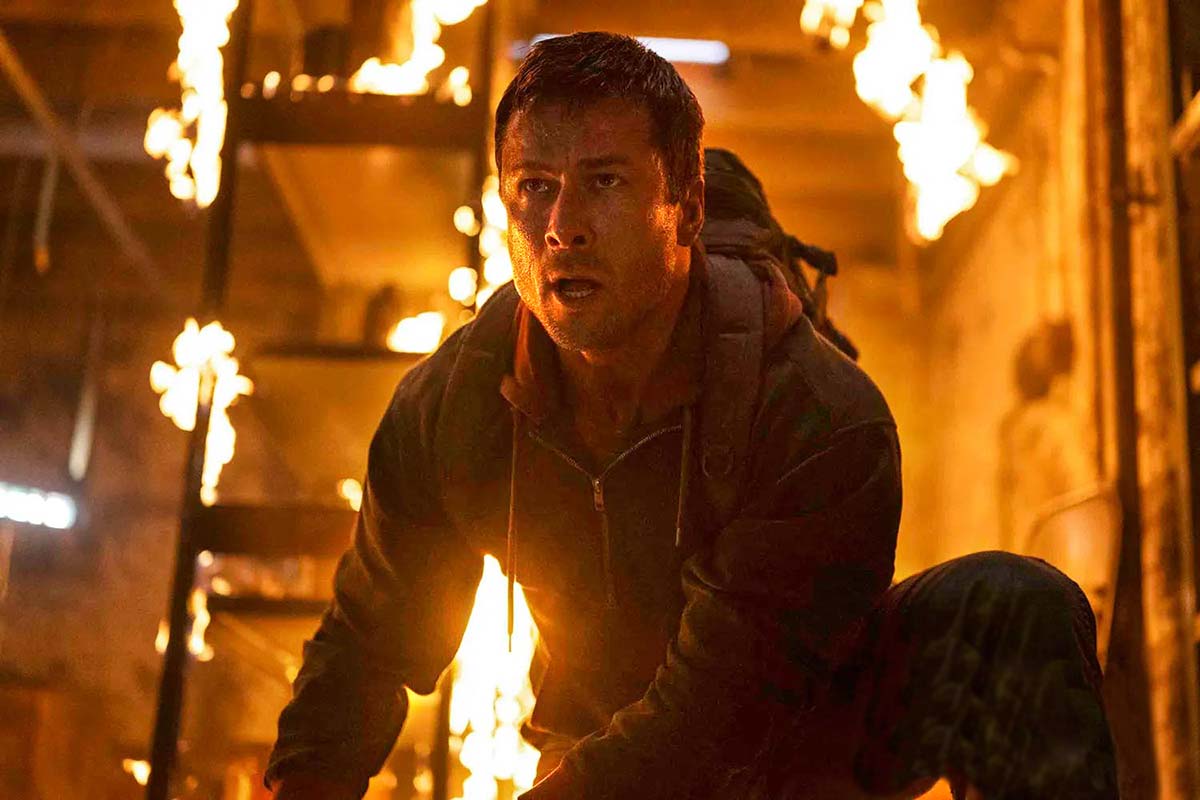
To be clear, the original 1987 film is dreadful. The type of ‘80s action sludge you would get with a bunch of swingin’ dick producers saying they just want a film with boom boom, without bothering to work out a coherent script.
It was an intended star vehicle for emerging action hero Arnold Schwarzenegger — when the original film was released, in mid-November, it was coming off his biggest hit to date, the estimable Predator, which had premiered at the beginning of the summer — as his name was becoming synonymous with such fare. As such, it gleefully included a meandering bunch of dumb-ass stunt pieces ending in bloody carnage with Arnold firing off one of his patented terrible, grim puns (“Need a light?” he would tell someone he just hit with a flamethrower; or “He had to split,” about someone he sheared in half) — but even for the rabid, teen boys whose foreheads it was aiming for, it didn’t do much at the box office.
Mind you, there remain critics of a certain vintage, who saw some of these rancid early Arnold movies — to this list, we can add Commando, Raw Deal, and Red Heat, among others — at a formative time in their lives, who will try to defend them as something other than violent cineplex trash. They will say the films are underrated, and attempt to justify their childhood nostalgia behind a cloak of formalism. Do not let their questionable enthusiasm sway you: Many of these movies are cynical, formulaic junk. It’s like rhapsodizing about a Happy Meal you had that one time, or how funny you thought “Three’s Company” was.
The 1987 version of The Running Man was depressingly stupid and poorly made — filmed with a last-minute replacement director in Paul Michael Glasser, best known for driving around a red and white Gran Torino with his good friend David Soul in the TV series “Starsky & Hutch” — with achingly stale “satire” (a TV poster in an executive’s office boosts a show called “The Hate Boat”) but there was a germ of a good idea there, taken from the novel by Stephen King, something that might have worked better had anyone actually tried to find it.
Enter Edgar Wright, the type of director who can handle action, satire and silliness in equal portions. This version runs considerably closer to the source material, which helps give its hero some emotional weight, as opposed to watching Arnold decimate everyone in his path for the sake of big-muscle violence.
Set in a future dystopia (2025, in the novel, to be exact, a hauntingly apt prediction, as it happens) where corporations have taken over the existing government, and rule the country with an oppressive iron fist, Glen Powell plays Ben Richards, a hard-working blue collar type, who has lost various jobs for his acts of solidarity and kindness towards his fellow workers.
Desperate for work, as his young daughter is badly sick and in need of medicine, and his wife, Sheila (Jayme Lawson), is forced to work at nightclubs where she gets propositioned all the time, Richards reluctantly agrees to audition for “The Running Man,” a sadistic and wildly popular game show, run by a slick entertainment executive, Dan Killian (Josh Brolin), and MC’d by a populist weasel known as Bobby T (Colman Domingo).
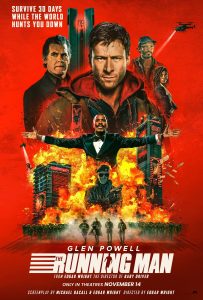
Naturally, Richards wins a spot on the show — his secret power, according to Killian is his rage, which the executive believes gives him an actual shot to win for the first time in the show’s history — along with a pair of less-likely contestants (Katy O’Brian and Martin Herlihy) who don’t last long. They are sent pell-mell out into the world, given a 12-hour headstart before the producers send out the Hunters, lead by bemasked psychopath Evan McCone (Lee Pace), to chase after them. In short order, Richards must elude the Hunters, and practically everyone else in the country, as any citizen who recognizes the contestant can call the network tip line and be richly rewarded. If he can survive 30 days of such deep inhospitality, he stands to win enough generational wealth to keep his family protected for life.
What follows is Richards’ sometimes clever, sometimes fortuitous spiked journey, meeting sympathetic people wanting to topple the hierarchy as he goes. The longer he survives — taping combative updates for the show, as per requirements — the more he becomes a sort of populist hero, the “instigator” as one character puts it, that puts a charge into the sense of rebellion in the country.
Wright is working more or less within his element here — stylized violence surrounded by biting satire (a recurring bit featuring a reality series called“The Americanos” — a Kardashian stand-in family — is particularly ripe) — and proves a good match for the material, even as King’s plot starts grinding its gears in the third act.
Wright’s version, while still substantially stuffed with action bits, does include a thread of more politicised criticism. Hard to miss the genuinely rebellious spirit of Wright’s vision (as one character puts it, the scariest thing in the world for a fascist regime is “a free man with a conscience”) as it plays out in a not-so-subtle backdrop of deep fakes, media caving in to a dictator’s whims, and mass cruelty as an opiate for the masses, as it were.
The director also has a good touch with layered action sequences — a fiery encounter between a be-toweled Richards coming out of a shower, and a group of agents at a Boston flop house anchors the middle of the film with deftly executed pizzazz — and remains near the top of his game for significant needle drops (the film opens with Sly and the Family Stone’s irrespressible “Underdog,” and features a deep cut Stones’ tune at the start of the Boston fracas).
More significantly, despite Richards’ character not quite adding up (Killian’s notion aside, Richards’ supposed rage seems to come and go as the plot sees fit, rather than being organic to the man himself) it actually makes sense — far more, it must be said, than with Arnold’s version of the character — that he could become a touchstone for a population stifled by oppression.
Making that work is largely the effort of Powell, whose supernova charisma powers much of the film’s breathless pace. Not only is he movie star good looking (and, shall we say, able-bodied), what comes across in his work is the palpable joy he seems to feel in producing it. Whatever hellish devilment he’s up against — and in this film, he’s subjected to quite a bit — you get the sense there’s no place he’d rather be. It’s a rare quality to find in an actor (and, perhaps, a fleeting one, depending on the stresses of one’s career), but it helps adhere an audience to whatever project they attempt.
Wright didn’t have to work terribly hard to clear the ground-level hurdle of the original, but he still injects enough fun and poignance to make the film a decent ride. It must be said, however, for all the ways this version eclipses Arnold’s, the films share one significantly unfortunate element: An ending that seems entirely too tidy and pat. You can’t win them all.