
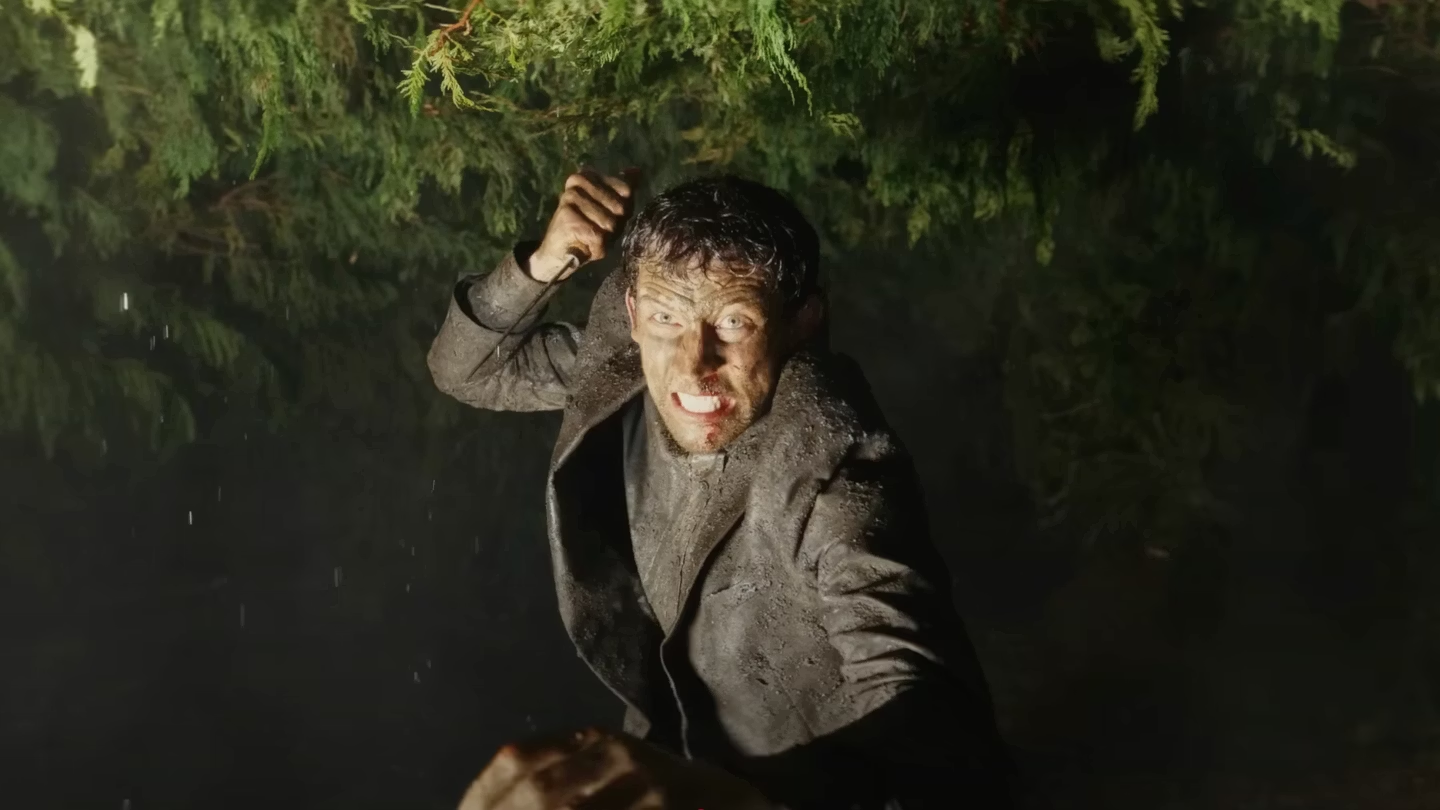
There are a great number of mysteries in Rian Johnson’s third leg of his Knives Out trilogy, many of which answered save one — at least expressly: Why does the lighting change so dramatically in many of the film’s most directly parochial scenes?
The answer, as you might surmise, in this religious fable cum muder mystery has to do with the characters’ various transpositions in mood and faith — the blaring symbolism of which Johnson doesn’t mind letting roar like the lions standing guard at the pearly gates.
The film, which played at the Philly Film Fest, after its world premiere at TIFF, offers more such (welcome) blatancy in its portrayal of an angry priest (Josh Brolin), who embraces his fury against all the supposed evils of the growing progressiveness in this culture, wishing commandingly for a return to power of his fellow white Christian men, turning his sparse flock into undying believers, no matter what evil he perpetrates.
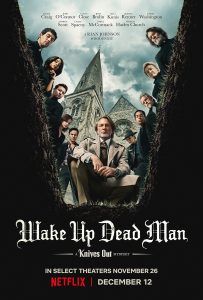
When he suddenly collapses and dies after one of his thundering sermons, the finger is pointed directly at a young priest (Josh O’Connor) new to the church, who stood opposed to his regressive regime. Enter, at last, Benoit Blanc (Daniel Craig), now with long hair and a pair of fetching, ‘70s style heeled boots, there to gather the facts, interrogate the suspects, and solve the “impossible” crime.
As with the previous two installments, what carries through most clearly is Johnson’s adoration of the genre, stuffing the film with red herrings, telling visual details, and a healthy stock of time jumps, forward and backward, as the story unfolds, reverses course, and unfolds again.
So why does the actual murder caper not resonate quite as strongly as the previous films? I would submit the most satisfying mysteries reveal themselves, at their conclusion, to be at least theoretically solvable by a particularly adept and observant patron. This film, with all its feints and flashes, proves to be largely unknowable — hence an extended closing confession scene that plays out more like an episode of “Scooby Doo” (unironically, a name Blanc himself sings out at one point), than a tightly wrought puzzle for us to grasp.
Still, much fun to be had — Andew Scott’s loathsome opportunistic fantasy author is a particular highlight — and Johnson’s dynamic story telling and cinematography— slow zooms, overhead observations, and a winning dolly zoom included — are absolutely first rate. Moods may change with the weather, but this series is still reliably entertaining at a high pitch.