Homer‘s The Iliad and The Odyssey were required reading for everyone I grew up with, and the one thing nearly all of us could agree on is that, had it not been required, none of us would have bothered. That’s not to say the works are without interest or merit — quite the contrary. It’s the rare mythical tale that doesn’t share some distant DNA with these 8th-century poems. The challenge is in the archaic presentation and maddening repetition. It was like trying to grasp the wonder of the Sgt. Pepper’s Lonely Hearts Club Band album by analyzing the grooves of the spinning LP.
The narrative tropes it popularized are nearly endless: the epic journey home, the steadfast believers holding out hope of the hero’s return, the treacherous acts in the absence of the hero, the cyclops, the Sirens’ song, transformational magic, the concept of the lesser of two evils. All of it (and more) traces back to this work.
The biggest burden in retelling such a foundational work lies in making it feel original. Enter writer/director Christopher Nolan. It’s not at all surprising that he’d aspire to take on such a project — his back catalog boasts many of the most complex plots in Hollywood history. The real curiosity is in Universal‘s backing of it. Imagine trying to sell them on the idea that Nolan was the guy best suited to retell one of the most impenetrable stories in literature. It’s like suggesting that the best way to put out a fire is by starting another fire. Then again, if ever there was a parallel to Homer’s approach, Nolan is undeniably it. Nested timelines, flashbacks, tying multiple time scales into one climactic scene — all are Nolan signature moves.
The grandness of his latest effort is apparent from the moment the first frame cascades across the screen. The sound effects and score drive up the intensity and never relent. Blinking becomes a risky proposition, and then we see the first crack.
Perhaps the most identifiable part of Homer’s tale is that of the Trojan Horse. It’s the hub around which everything else spins, but it just doesn’t work. The first time we see it, it feels artificial — this wooden creation gives the appearance of a bronze statue from all but the close-up shots. In fact, the CGI throughout the entire film is second-rate at best. Every long shot suffers as a result, but it’s not just the CGI. Nothing about the statue is believable — not the number of people in it, not the way it holds up to being transported, not the way the attackers exit from it. Nothing. Monty Python‘s Trojan Rabbit is more authentic.
The biggest distraction, however, is the contemporary dialogue and look. Everyone has perfect hair, perfect makeup, perfect teeth, and a perfectly American dialect and syntax. Odysseus’ son, Telemachus (Tom Holland), can’t be bothered with any persnickety “fah-tha” references when “dad” is so much cleaner. Ugh. I can’t help but think of Darth Vader telling Luke, “No, I’m your pa.”
There are also more than a few moments where the film feels, frankly, a bit full of itself. I thought Nolan had left that propensity behind with Oppenheimer, but alas, not.
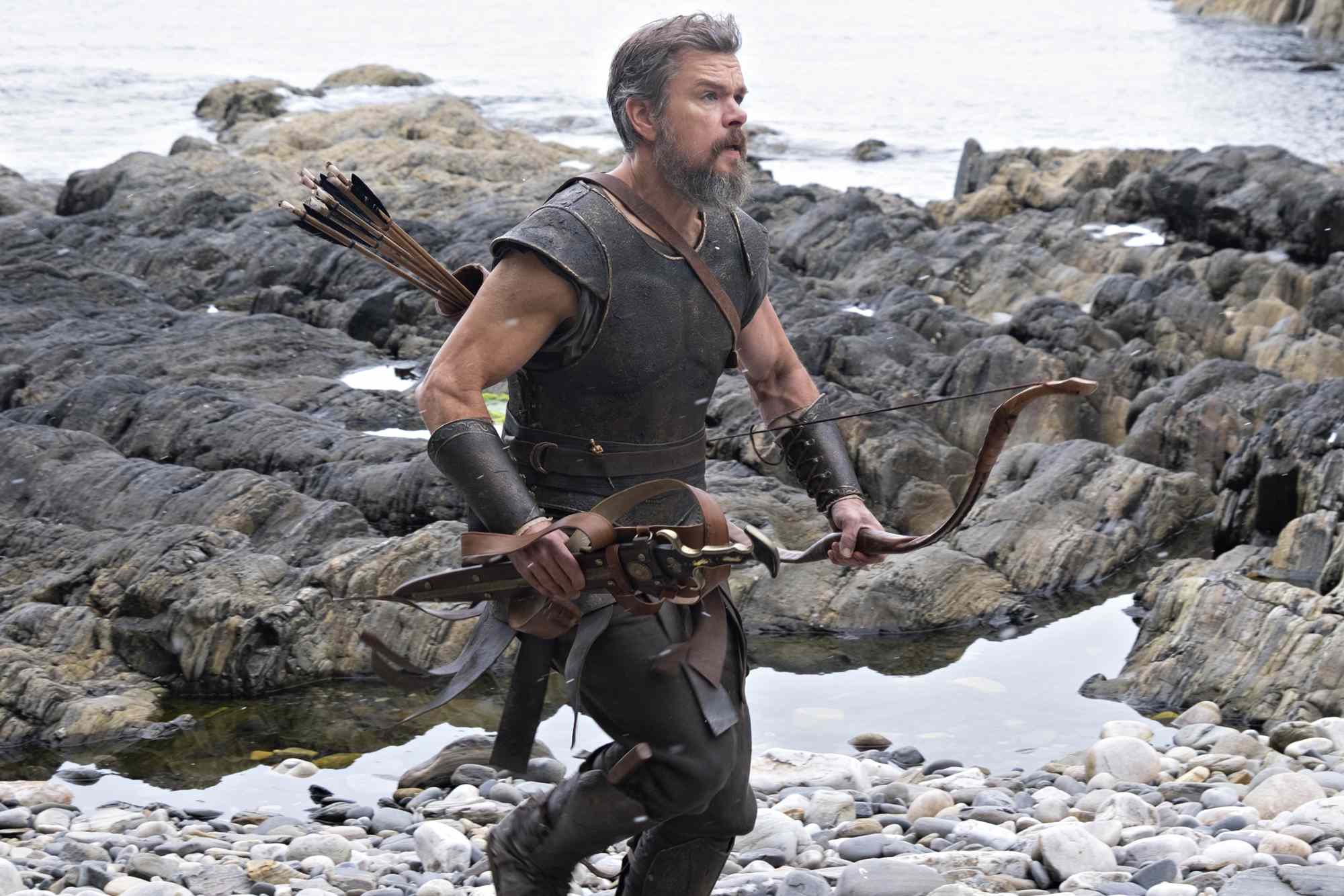
The rest of the content is done with typical Nolan mastery. The action sequences are often mesmerizing and electric. The performances are, for the most part, well executed. Most notable is Holland, who imbues the role with the perfect mix of innocence and ignorance. Matt Damon is predictably perfect as the everyman hero Odysseus, and Anne Hathaway finally gets a chance to play a role that doesn’t keep her stuck in perpetual gaiety. There’s also the return of Elliot Page to the big screen — a choice that Nolan deserves much credit for making.
Many will compare this film to 2000’s Gladiator, and it’s an apt comparison, for better and worse. The look, breadth and main protagonists are quite similar, but so too are many of the missteps. When it’s rolling, it flattens everything in its path, but when the momentum ebbs, it struggles to get it back. This is a grand-scale tale, filled with sweeping moments, that suffers at times from being more Simpson than Homer.