
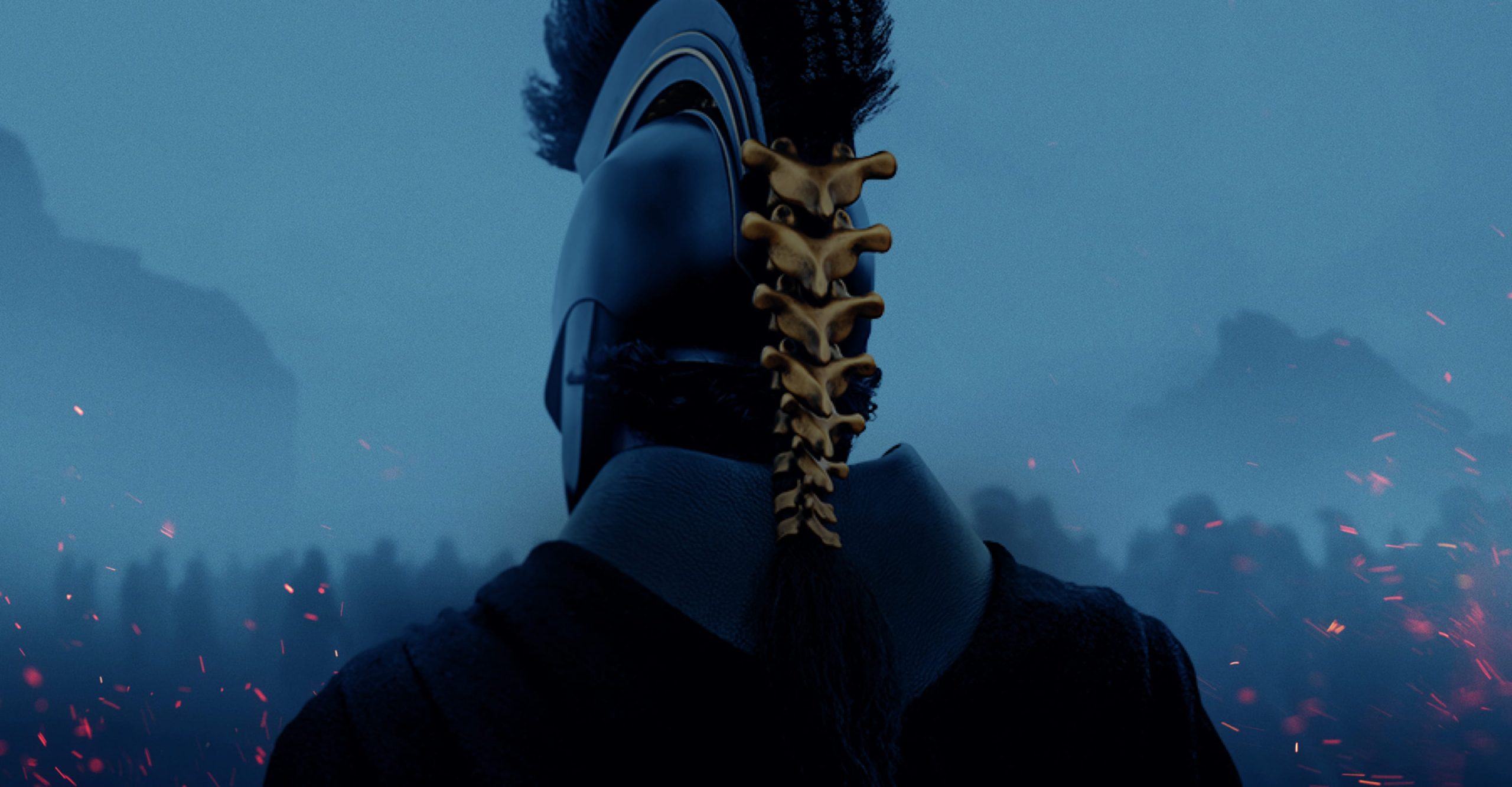
The ancient Greek idea of “Zeus’ Law” was a simple one: If a stranger came to your door, even dressed as a beggar in rags, the host was expected to open their home to them in welcome, offering food and drink as well as a place to stay the night. To the Greeks, Zeus had so decreed this because he, along with other gods, had a penchant for stepping off of Mount Olympus in disguise and mingling with the regular folks who worshipped him. Maybe the raggedy stranger at your door was actually a god in disguise, in which case, you’d better be congenial and open-hearted else they turn you into a spider, or newt, or condemn you to carrying leaking pitchers of water into a bottomless pit for all eternity. It was an act of camaraderie disguised as an act of survival.
In writer/director Christopher Nolan’s conceit, this idea of openness and trust was betrayed by Odysseus (Matt Damon), in tricking the Trojans to accept the “gift” of a giant wooden horse, secretly filled to the rim with Greek warriors, all of them furious and miserable after spending the better part of a decade away from home in order to win the war for their king, Agamemnon (Benny Safdie). After the appreciative Trojans dragged this giant horse into their city as a symbol of peace with the Greeks, Odysseus and his men snuck out of the structure in the middle of the night, and opened the previously impenetrable Trojan gates in order to let the rest of their army inside, sacking the place in a fury of raping and pillaging. Odysseus won the war, such as it was, but, as Nolan has it, lost a good bit of humanity in the process.
If the idea of Nolan utilizing an older, guilt-ridden protagonist — who suffers both from his own vanity, and also the capriciousness of the gods — feels vaguely familiar, there is certainly a through line between Odysseus’ consternation at bringing about the death of civility and honor, and the guilt of physicist Robert Oppenheimer, from Nolan’s Oscar winning Oppenheimer, realizing to his horror the nightmare he unleashed on Earth. In Nolan’s view, both men are forced to suffer from their consciences as a direct result of their greatest accomplishments.
Homer’s epic poem, one of the earliest examples of written narrative, is so filled with adventure (Cyclops!) and spice (Sirens! Nymphs!), it’s no wonder Hollywood keeps coming back to it — including a competing version from this year that features heavy use of AI — but this might be the first version to feature Odysseus lamenting to his wife, Penelope (Anne Hathaway), not yet realizing the beggar in rags speaking to her is her long-lost husband, the tremendous guilt and misery he feels at betraying both the gods, and the good intentions of man, in order to win a war for his king.
Naturally, Nolan takes some other liberties to streamline the story (though, for Nolan, a director notorious for long running times, “streamline” might be a bit misleading for this three-hour epic). We learn precious little about Calypso (Charlize Theron, mostly wasted), for example, the nymph who seduces Odysseus with Lotus flower to stay with her in a drug-induced haze for years, temporarily forgetting about his family back home in Ithaca. Still, Nolan’s style, grandiose and self-serious, serves the epic form well, giving considerable heft to a set of myths that cohere together fetchingly.
Matt Damon, long of beard, and cut of abdomen, embodies the worn-out weariness of Odysseus, underplaying his heroics as a job he’s been pushed into doing, and suffering for his successes. Less effective is Tom Holland, playing Odysseus’ son, Telemachus, a young man forced to watch his mother suffer from her grief, while a veritable army of ill-mannered suitors, led by the honorless scoundrel Antinous (Robert Pattinson, relishing the role of the evil heavy) swirl around her, hoping to be the next king. The now 30-year-old Holland somehow still seems too young and callow for such a role, and his heavy Americanized accent, accompanying Nolan’s unfortunately colloquial screenplay (he often refers to Odysseus as “dad,” which sounds just as awkward as you imagine) reduces the character’s poignancy.
Indeed, if Nolan has one major misstep here, it’s to replace Homer’s dense, lyric prose (“Hear me,” he cried, “you god who visited me yesterday, and bade me sail the seas in search of my father who has so long been missing. I would obey you, but the Achaeans, and more particularly the wicked suitors, are hindering me that I cannot do so”) with clunky, modernized vocabulary that too often sounds like a teen Netflix special (“I need everyone in this party dead”). It’s clear that Nolan didn’t want the language to stand in the way of an audience’s understanding, but in modernizing it to this degree, he actually takes away from the conviction that the fabulous visuals convey. It’s like listening to an incredible orchestra beautifully playing “Don Giovanni,” with Britney Spears warbling the vocals.
Visually, the film is a knock-out. Behind the luminescent work of longtime Nolan DP collaborator Hoyte van Hoytema, the ancient world is rendered with stunning precision and depth. A single shot of Telemachus plunging from a building through a doorway — vaguely reminiscent of something out of The Searchers — strikes you with its assuredness. Shot on location all over the world, and including Nolan’s penchant for practical (not CGI) effects, Odysseus’ journey has never looked better on film. Shot entirely on IMAX 70mm, it feels like an appropriate throwback to the Hollywood epics of ‘50s and ‘60s, only with thunderously better effects (the CGI for the cyclops, his face twisted as if paint swirled with an artist’s finger, should fill Marvel with shame). If only these resonating visuals weren’t hamstrung by Nolan’s dumbed-down dialogue.
What we’re left with then is about 66% of a stunning epic — and it goes almost without saying, if you plan to see the film, see it in IMAX, or at least as large a screen as you can get to — a better percentage than most summer tentpoles, even if it feels a step down from Oppenheimer. As Odysseus himself says (ironically echoing a different Matt Damon role, that of a shill for Crypto), “fortune favors the brave.” Nolan, one of the few working filmmakers in the world who can literally make anything he chooses to with a studio’s blessing, has produced a fiery Hollywood epic, filled with lightning and thunder, even as it too often sounds like an episode of “Outer Banks.”

2 Comments
We share much of the same admiration as well as many of the same grievances here, and I think you summed them up quite well! The mismatch between epic visuals and colloquial script is what most bugged me, I think (aside from the lack of grounded, Greek culture). In a different review, someone suggested such an adaptation requires, in their eyes, a distinct motive or purpose to feel justified. What do you think of this notion? Do you feel Nolan added anything interesting and/or unique to the story, or was it more spectacle than anything?
Well, he did add the element of Odysseus’ guilt at destroying Xenia (Zeus’ Law, in the film), which gives a more complex view of the man — that does seem justified, at least.