
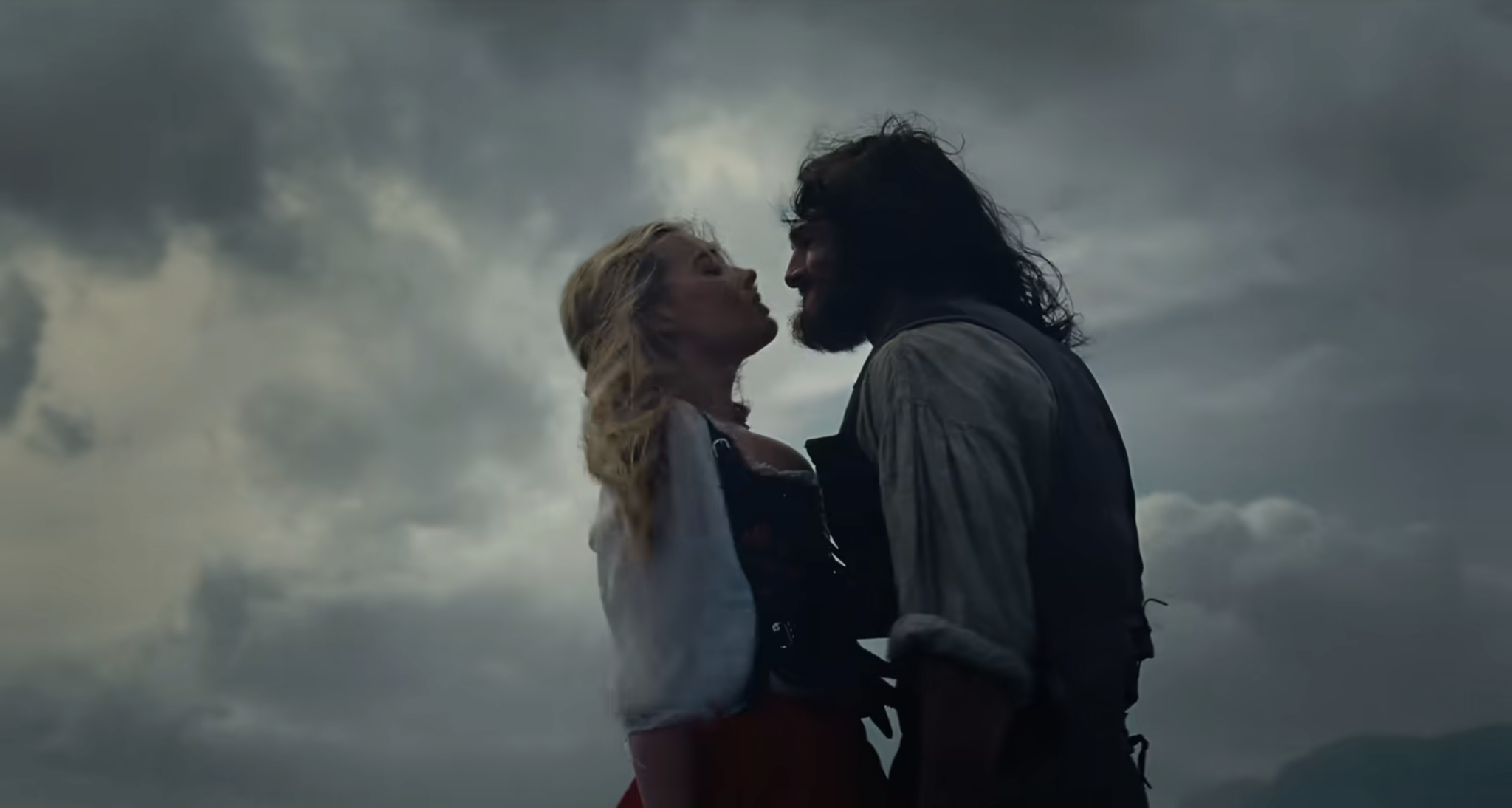
The original Wuthering Heights — penned by the tragically short-lived Emily Brontë and published in 1847, is often required reading for students across the English-speaking world. Revered as a cornerstone of Gothic fiction, it’s packed with psychological intensity, ornate prose, and a cast of memorably despicable characters. That rich source material has inspired more than 30 major adaptations, with the 1939 version starring Sir Laurence Olivier and Merle Oberon widely regarded as the definitive interpretation.
Enter writer-director Emerald Fennell, whose previous work has shown little interest in preserving any hint of decorum. She makes that clear within the film’s opening moments, teasing a traditional approach before abruptly pulling the rug out from under the audience. From that point forward, it’s evident this will be a very different creature.
Margot Robbie, as the wistful and winsome Catherine, proves an inspired choice. Her natural charisma draws the viewer in with the ease of a siren’s song. Opposite her, Jacob Elordi’s Heathcliff matches her intensity. His seemingly youthful protectiveness gradually reveals a simmering capacity for dominance and control. Together they command the screen, as nearly every other character seems paralyzed in their orbit.
There’s a scene between Heathcliff and the achingly innocent Isabella Linton (portrayed flawlessly by Alison Oliver) that lays bare the expertise of every player. On the surface it exposes the imbalance of power between the two characters, but it’s so much more. Fennell, fully aware of the need for consent between lovers in our era, wields this foundational thinking as a weapon. Heathcliff toys with Isabella’s desperation, knowingly and repeatedly asking, “Do you want me to stop?” The manipulation is chilling — and impossible to forget.
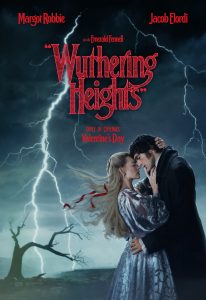
Let’s be clear: purists of the novel are likely to be disappointed. This is not a faithful retelling but a near-total reimagining. Fennell might have avoided backlash by prefacing the film with “Inspired by” rather than presenting it as a direct adaptation. For viewers willing to let go of expectations, however, her interpretation becomes a lush, unrestrained tapestry. It’s a brutally candid exploration of lust, obsession, and grief, deliberately blurring the line between romantic drama and psychological horror.
Fennell’s vision transforms even the most mundane objects into loaded symbols — tools expertly sharpened for maximum emotional impact. I will never look at eggs the same way again. The world she constructs is beyond immersive and unapologetically dark: brooding, foreboding, and at times oppressive, aided significantly by Charli xcx’s striking soundtrack. This is Wuthering Heights liberated from the constraints of its era — unbound from the social strictures of the mid-19th century. It’s raw, racy, unsettling, and, at its best, electrifying. Where Brontë produced a whirlwind, Fennell unleashes a tornado.