
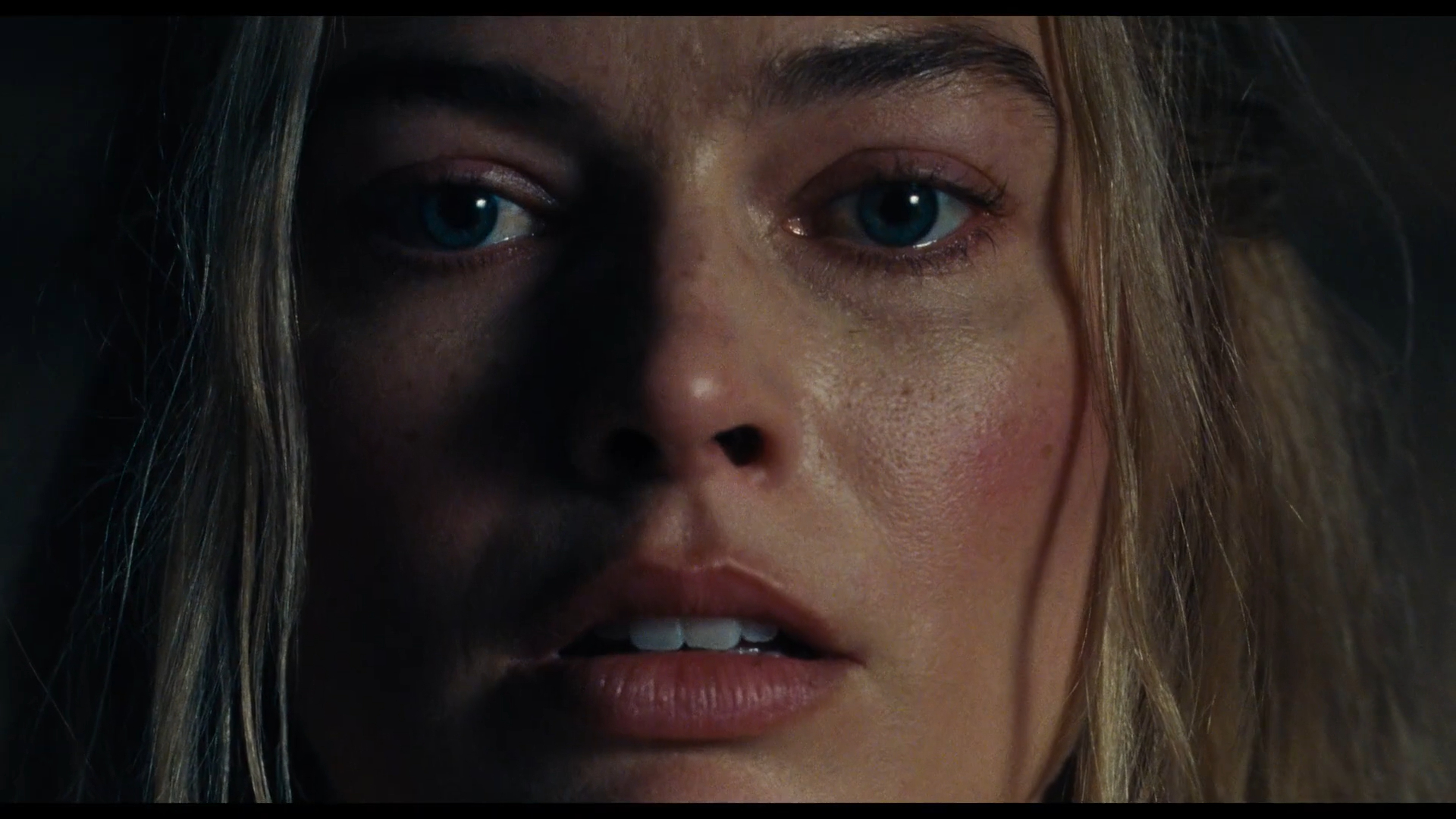
Emerald Fennell’s literary adaptation of the much revered 19th century novel by Emily Brontë begins with a sound, a muffled series of moans and sharp intakes of breath. For all the hype about the film’s ballyhooed sensuality, the implication is immediate, and faintly transgressive, as if the sexual charge of the film comes even before any imagery. It turns out, however, that the moans are being made by a man, not in the throes of passion, but draped with a death hood, in the process of being hanged.
Fennell, whose reputation as a cinematic provocateur comes from a pair of hotly disputed previous films, Promising Young Woman, and Saltburn, seems to be setting up a kind of punishment for our expectations: If we were imagining one of world’s most endearing tragedies about passion being turned into a sexually frank and explicit drama, Fennell suggests strongly we think again. That more or less holds true for the rest of the film. As much as the trailer suggests an unhinged, psycho-sexual bacchanalia, the actual event is far more tame — at least, graphically — than what we might have imagined.
Heathcliff (played as an adolescent by Owen Cooper), a beggar’s child, is brought to Wuthering Heights by its drunken landowner, Mr. Earnshaw (Martin Clunes), who takes pity on the child as he’s being cuffed about by his lout of a father. At the venerable, forbidding estate, Heathcliff makes quick friends with Catherine (played as a young girl by Charlotte Mellington), and the two quickly become inseparable. At night, they spy on each other through the warped windows between Catherine’s bedroom, and Heathcliff’s makeshift straw bed across the way in the upstairs of the barn.
Over time, he becomes thoroughly entranced by Catherine, eventually accepting beatings on her behalf from the emotionally volatile Earnshaw (“I will gladly take this and more every day, if it spares you,” the boy solemnly intones), to the continued consternation of Nelly (as an adult played by Hong Chau), Catherine’s maid, who shares no love for either of them.
From there, we jump ahead an indeterminate number of years — long enough, essentially, for the two adult leads (Margot Robbie and Jacob Elordi) to be safely inserted in their roles. Earnshaw is even more of an ill-tempered sot, having whinnied away his modest fortune on gambling, leaving the family penniless. As financial desperation takes hold, the new arrival of the exuberantly wealthy Edgar (Shazed Latif), and his teen ward, Isabella (Alison Oliver), just down the mountainous hill from the Heights, offers at least the possibility of financial redemption.
Given the choice between a marriage proposal bequeathed by the rich Edgar, or running away like a pair of vagabonds with Heathcliff, Catherine makes the financially-sound-but-emotionally-devastating choice to make do with the loving Edgar, in his resplendent castle, rather than follow her heart’s desire to be with Heathcliff. Overhearing her choice, as she explains to Nelly (who allows her to go on, even though she’s aware of Heathcliff’s presence outside their door), Heathcliff takes off in the night on a stolen horse, and is gone for several years.
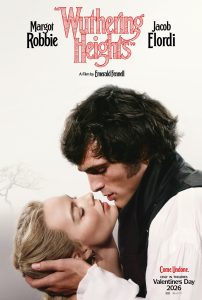
Upon his return, suddenly wealthy, and wearing the fine garments of a gentleman, with the demeanor and bitter heart of a spitefully jealous demon, Heathcliff pursues Catherine at every turn, until finally they are able to fulfill their undying passion for one another, until things get progressively darker for everyone.
Curious decisions abound in Fennell’s fitful concoction: Eschewing a sizable racial/class element from Brontë’s novel, where Heathcliff comes from unknown but ethnically diverse roots (it is suggested he is of Spanish/Roman or Middle Eastern descent), adding to his alienation from British society, Elordi, as physically imposing and handsome as he may be, is plainly caucasian as skim milk. Instead, in her retelling, Fennell has cast the partially Pakistani Latif as Edgar, upsetting the racial dynamics considerably, and to an end that seems ambiguous at best.
Her racial tinkering aside, her more anomalous choices involve the film’s production design, which goes for operatic-level blatancy — cutting back and forth between the dark, dirty Heights, with its dingy corners and loosened floorboards, surrounded and caged by peculiar rock obelisks that seem designed to keep the inhabitants in perpetual claustrophobia; and the grandly opulent mansion, all pouring light, bold colors, and enormous great rooms, where Edgar and Catherine abide, is like traveling from a dank plane of hell to Versailles — but comes across as shamelessly overt as anything from the Zack Snyder canon.
The other, more understandable misstep comes with Fennell’s casting: As good as Robbie is (and she’s more than fine), the 35-year-old actress simply doesn’t have the means of conveying the vastly more adolescent Catherine, nor does the film make sense out of the casting of Elordi, some seven years younger than Robbie, even though, as children, Heathcliff is at least several years older than Cathy. In fact, the tender emotional depth of the characters are far more successfully rendered by the younger versions of the characters, Cooper and Mellington, whose vulnerability and care for one another seems to emanate far more organically.
Beyond all of that, we are left with elements of Fennell’s fervent, peculiar sensuality: In place of standard graphic nudity, we are instead given bizarrely tactile references — the gelatinous sop of egg yolks on a mattress, say, or (as lovingly depicted in the trailer) the skin-like, flesh-colored padded wall panels of Cathy’s bedroom in Edgar’s manse; and, as always, Heathcliff’s penchant for licking everything from those walls, to Cathy’s fingers, and even her tears. It’s clear to see the vibe Fennell is going for, but the film jitters between elements — one minute, playing it more or less straight, the next shooting for Ken Russell-style visual overdrive — which, in the end, makes it feel almost schizophrenic, or at least, unmoored (as it were).
For a far better rendition of the novel, that vastly better captures the madness and moodiness of the novel, one only has to go as far back as Andrea Arnold’s 2011 adaptation, a sumptuous and morose work that radiates sharp lyricism. But in this ungodly year of our lord 2026, perhaps Fennell’s bizarre juxtaposition of chaotic style choices is the version we deserve.