
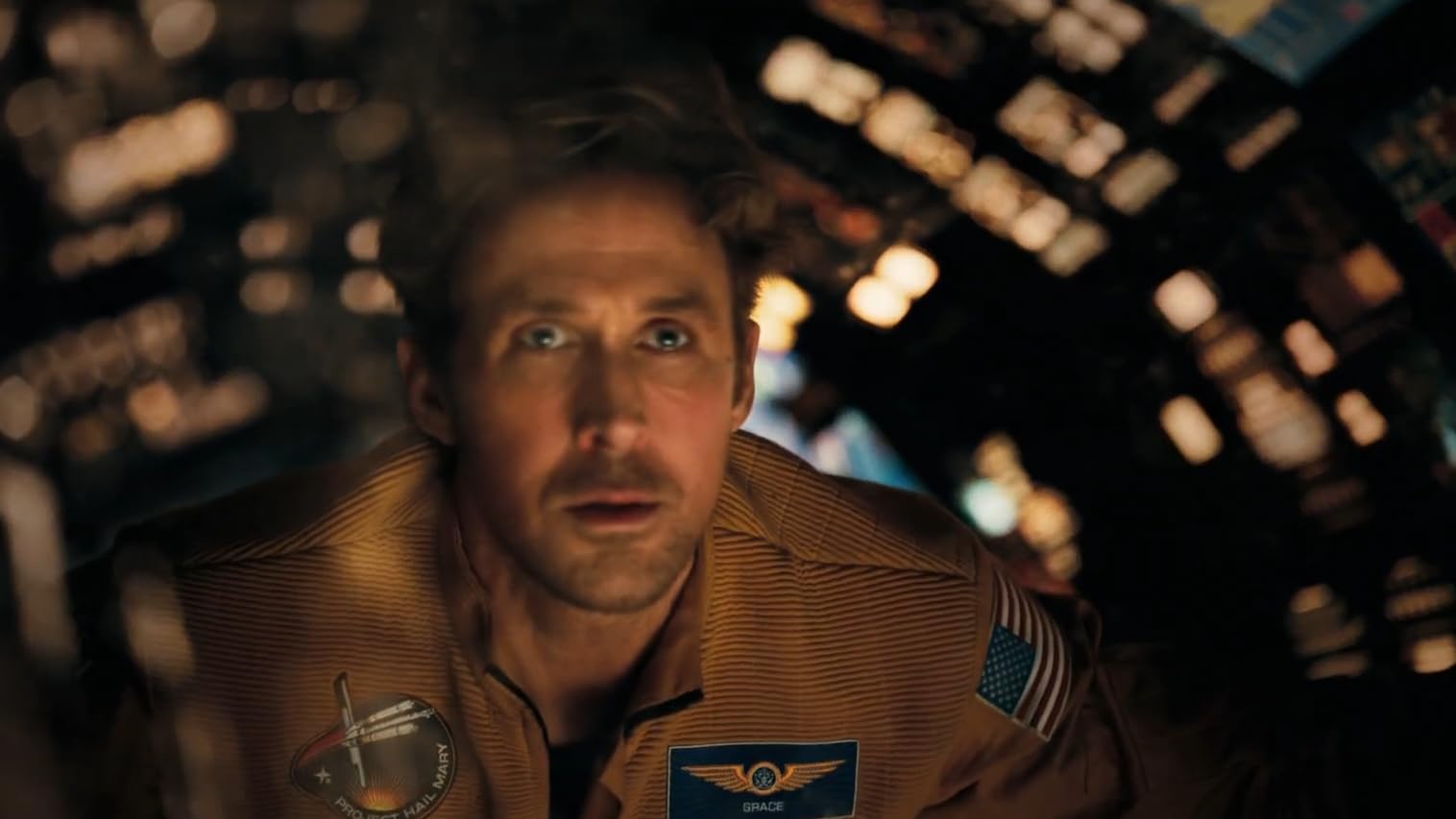
In an interstellar tube connecting an Earth-based ship to an elongated alien vessel, the lone human survivor of a mission to save the sun finally meets, through tempered glass, a likewise-minded lone surviving alien — comprised of what appears to be various forms of rocks — from an even more distant planet.
The alien and the American scientist attempt to communicate directly, but it seems hopeless. That is, until the scientist realizes his alien counterpart is mimicking his movements in a way to convey connection. Beginning with simple gestures, the scientist quickly jumps to a series of cheesy, familiar dance moves — all syncopated walking and pelvic thrusts — that the alien also emulates, and soon the two are cavorting about as if members of a ‘90s-era boy band.
If this feels a bit contrived — and I certainly wouldn’t blame you if it did — that’s essentially the spirit of this achingly convivial sci-fi caper, directed by the team of Phil Lord and Christopher Miller (Clone High, The Lego Movie, and the Spiderverse films), from a screenplay by Drew Goddard, based on a novel by Andy Weir (The Martian). As with the previous adaptation of Weir’s work, it’s a film that gleefully presents basic scientific principles and logic clumsily sewn together with a story and outlook that feels very much like something an enterprisingly affable 15-year-old might come up with while daydreaming in Physics class.
The surviving human scientist, Ryland Grace (Ryan Gosling), wasn’t even meant to be part of this last-ditch plan to save the world. He was happily working on the biological problem of the “astrophage,” a microscopic species of indeterminate origin who float through the galaxy, draining star energy, as with our Sun, and the subsequent planets and stars all around them in order to reproduce and continue their onward trek.
With the sun draining of energy, the threat to Earth is palpable and potentially devastating. Project leader Eva Stratt (Sandra Hüller) suggests a third of humanity will be wiped out by famine within a matter of years. In desperation, a global coalition has cobbled together an international team of scientists, politicians, and astronauts to solve the problem. Their best chance lies in a distant star some light years away that has somehow proven resistant to the astrophage’s entreaties. The mission then, is to travel to this planet and discover the secret of its success with the hope that it can be quickly replicated back in our own solar system.
Initially, Director Stratt has a full team of skilled astronauts and scientists ready to roll, along with their redundants in case of trouble, but mere days before the launch of their ship, an explosive catastrophe takes out all but a pair of astronauts, forcing Grace to reluctantly join the rest of the remaining team members, each of whom understand this is essentially a one-way mission with no way of returning home.
As Grace awakens from his hypersleep coma, long-haired, bedraggled, and disorientated, he realizes to his horror the other two members of his team have died in transit, leaving him seemingly alone, and highly unqualified to handle the mission which, due to coma-related mental atrophy, he can’t even quite remember. All of which is context as to why, when he meets the aforementioned alien, whom he dubs “Rocky” (voice of James Ortiz), he is greatly relieved to have a companion with whom he can work to save the galaxy from imminent doom.
Their dancing meet-cute sustains their relationship, which, after Grace rigs up a communication translator for them, more or less plays out like a buddy comedy. Rocky is messy, and can hear anything Grace says from anywhere, no matter how he tries to whisper into his video log; Grace is goofy, always ready with a quip to lighten the mood, no matter the stakes. This kind of low-key good nature plays into Weir’s sort of relentless optimism — say what you want, at this point, it’s pretty clear that the man at least understands his strengths as a writer: He likes working with heady, practical-but-unserious male protagonists, working alone in survival mode in space.
There’s nothing inherently wrong with this, of course, and as painful as the non-space sections of The Martian were (let us just say human relationships aren’t really in Weir’s artistic purview), the science-based stuff was certainly engaging enough to hold our interest. Here, though, Lord and Miller double-down on Weir’s more fanciful impulses. Grace, ably played by Gosling, is a man-child with very little of what you might call an emotional center. He seems as unencumbered by the understanding that he’s alone in the universe, hurtling through space on a suicide mission as a teen might be heading out one night for a Crunchwrap Supreme.
As represented, he has no family, no close friends, no emotional attachment to anyone, in particular, until Rocky comes around, which, while eminently conducive to Weir’s plotting mechanics, doesn’t resonate as particularly human. As charming and vivacious as Gosling is (the man could bring a level of affability to a bucket of nails), it makes less and less sense that he would be so unperturbably alone in the world. His outlook is so breezy and sophomoric, there’s very little emotional weight to him. In fact, the only compelling complication to his character — the fact that he actually refused to go on this mission out of cowardice, but was drugged and forced aboard by Director Stratt — doesn’t ultimately lend any further exploration of his psyche: Now that he’s here, he has no problem doing the right thing, even at risk to his life.
Worse, the film too often defaults to this sort of cringey geniality, a simplistic view of human emotional mechanics that renders the drama toothless. Like a warm-hearted kids’ Disney movie, you know full well things will turn out just fine for our heroes, and the galaxy they’re defending, because the film constantly telegraphs its cheerful intentions. In one scene, near the film’s climax, Grace and Rocky are attempting a bold maneuver to capture some of the biological matter in the atmosphere of the resistant planet, when things go horribly wrong, forcing Rocky to emerge from his in-ship glass cocoon in order to save Grace, at great physical cost to himself.
When Grace comes to and realizes the sacrifice his friend has made for him, he scrambles to restore Rocky’s habitat. This could be played for pathos and drama — maybe, at last, the film’s stakes are set out for us! — but, no, Grace plays it as if Rocky will always recover, with no harm done.
It’s as if Lord and Miller (and Weir) are afraid of making the audience feel real anxiety or stress, so like a second-grade teacher explaining the concept of greenhouse gasses with their students, they work very hard to let all of us know everything will work out okay. It’s certainly not the worst quality in a film, but its lack of stress well belays its extended run time (156 mins), and makes for an unsatisfying experience: My parents saved the Cosmos and all I got was this lousy t-shirt.

6 Comments
Wow, you’re going to be made to look like those people who gave star war 1 out of 5 when it was released. And the book is outrageously good btw. Hope, friendship, happiness and sacrifice not doing it for you? Were you a goth?
Yeah Piers seems like a deeply unhappy person lol
This guy is a hater. Just look at his past reviews. I suggest a different line of work that you might enjoy more buddy, this gig clearly isn’t working out!
This review reads like it was written by an edgy fifteen-year-old. Is the bar really this low for writers? I haven’t even seen the movie and already know this is all mostly BS. Piers, you suck at your job.
Can’t talk about the movie, but you talk trash on the book that’s rated 4.9 stars? This is just contrarian nonsense. The book is phenomenal.
Your review is excellent, sharp and accurate. This is a cozy film-flam alien encounter movie, enjoyable enough (just about) to keep you watching but juvenile in so many ways. The way the main character goes from no single word of language with the alien to – 30 seconds later – 250 words, then by the next scene almost full conversions (including allusive jokes, irony all understood etc) betrays its silliness from that perspective. It desperately, as you say, needed to get away from the Disney feel-good, but never did.